Thursday, October 25, 2012

The 329th good thing about Lagos: quilting time

I've had a fun time in Lagos learning about quilting.  I've been a part of a fun quilting group and we've had some expert quilters who have shared their expertise with many of us beginners.  I love the vibrancy of African fabrics and I've enjoyed using them in some pretty wild quilts.  I'm definitely not into traditional quilts.   Here's pictures from some of the quilts I've worked on during my time here.
 
This one is a baby quilt that I made for Natalie, my granddaughter.
This quilt is from a pattern called the "Steps to Freedom."  It's one that many of us in the quilting group have made.  It's a relatively simply pattern and it's a fun, scrappy quilt which showcases a variety of fabrics.  We share fabric scraps in the group so we can get a good variety of fabrics for this quilt.

I made some quilts using blue fabrics for presents for two grandsons.  They're pretty wide and crazy.

My daughter-in-law is as new as I am to quilting, but she has a real gift both for composing and creating quilts.  My quilts are amateurish compared to hers.  She also was really productive, at least until the baby she's holding in this picture (my youngest grandson, Mason) got mobile.  And she has 4 young children!  I couldn't believe how many beautiful quilts she was able to finish.  She was very nice to quilt these two large blue quilts on her mom's long arm quilting machine.
My latest quilt, which I finished piecing over the summer is one called a "stack and whack" or a "one block wonder" quilt.  The quilt top is made from using just one fabric, but the pattern is made from how that fabric is cut and put back together.  The quilt top is composed of hexagons made up of triangles that are exactly the same pattern, cut from stacking 6 pieces of fabric on top of each other.  Because the triangles have sides of equal length, each hexagon can have 3 possible variations depending on when corner is in the center. 
The the hexagons are organized into whatever seems to be a pleasing pattern.  This next photo is the hexes arranged on a "design wall."  When they are sewn together, it is done with half hexes sewn in strips, so that part isn't as hard as it may look.   I loved doing this quilt.  It looks like a kaleidescope.  It also wasn't that difficult, though it looks pretty complicated.
I used some of the original fabric around the border of the quilt on the top.


And I also used the original fabric, with some yellow border fabric on the back, so you could see what the fabric looked like in the original state.  My daughter-in-law is also going to quilt this one for me.  I'm excited to see what the finished quilt will look like!
 

The 328th good thing about Lagos: Children's Museum Day


Last May on the day I was leaving Lagos for the summer it was Children's Museum Day at the National Museum.  I had been there for this celebration before and I really wanted to come because the kids are so cute, many of them dressed up or costumed for the occasion.  So I made sure I had my bags packed and ready to go so I could stop over for some of the program. 
 
When I got to the museum, the program was already in progress and prominently in front of the performance area was this car.  I knew there was a "big man" there....
 
The license plate on the Rolls told me who it was -- the Ooni of Ife.  I knew that later in the day at the Museum they would be opening an exhibition of the Art of the Ife.  It is a great exhibition that had travelled to museums around the world, including the British Museum and I had seen it at the Museum of Fine Arts in Houston.  So the King -- called the Ooni -- was there, I'm sure, because of the exhibition opening.  He certainly gets to ride in style.  
 
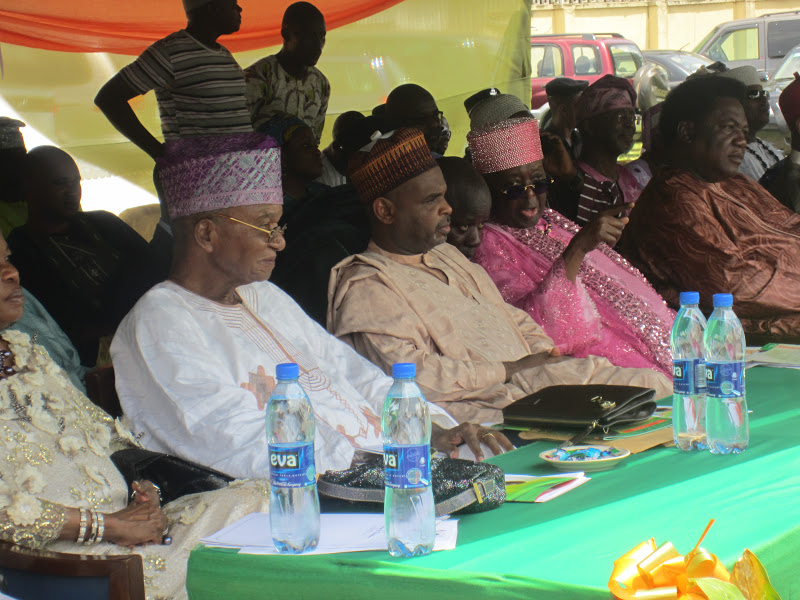
Don't know which of these guys is the Ooni, but there were lots of "big men" there.


There were lots of dancing performances from different Nigerian cultural groups.


These dancers with all the coral in their dress are from Benin City.


I got some pictures of cute kids in costume waiting in line for the toilet.


Nigerian children are all so beautiful!

Tuesday, October 23, 2012

The 327th good thing about Lagos: a nice guy making good ceramics

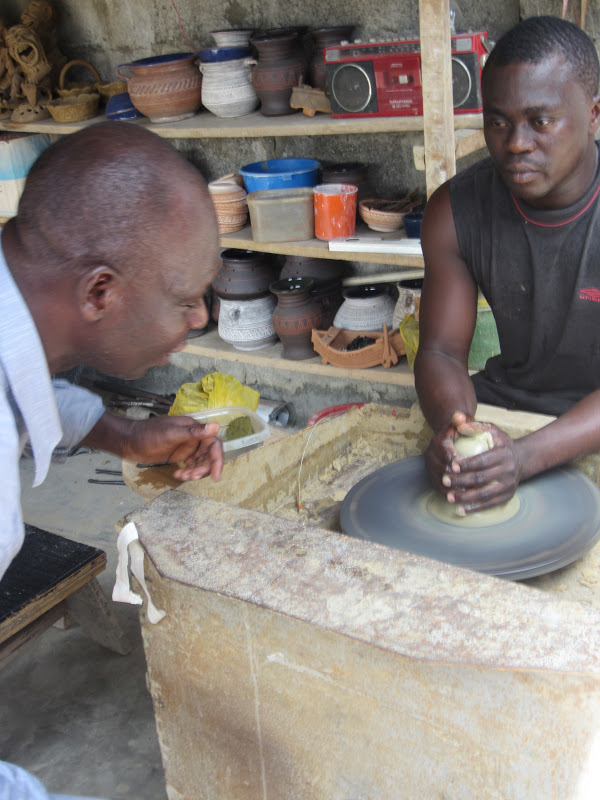
Charles is a potter who is enjoyed and supported by many of the expatriate women in Lagos.  He's from Ghana and got a leg up on his business by the American Women's Club and by some expat women individually.  I don't know if they still do, but I know women who have shipped in materials for his glazes when he couldn't get what he needed here.  He's a nice guy who really appreciates and recognizes the help and his business has grown into quite a good enterprise.  I stopped by his place of business one day to pick up some pots that I had asked him to make for me and he gave me and my driver a demonstration of his work.  He's also started doing classes for people to come and try their own hand at making a pot. 
 
I've always been amazed at how easy potters make it seem to build a smooth pot on a wheel.  I've tried it and it really isn't very easy.


He also has someone now who is making glass beads for jewelry and the decorative strands they have here.  It was interesting to see how these are made, because I certainly have been an regular customer of glass beads here.


 Here's his little shop.  He makes pots large and small and lamps and dishes -- decorative as well as functional items.  He really does quality work.  He makes dishes with green glaze or a beautiful dark blue glaze.  When I'm buying for myself, I get the green glaze. 


Here's some examples of things I've bought from him.  I asked him to make the berry bowl for me, as I saw one in the States and I thought it was nice, to have a bowl with holes so berries could breathe and not get moldy.  I don't have fresh berries much here, but I thought it would be useful back in the States.  The little shallow bowl is a nice size for a dessert dish.  Some of his dishes are glazed on the outside and some are left unglazed, but decorated with designs.  If any of my US friends are interested in getting some of Charles' pottery, let me know what you want and I will bring it back for you when I come at Christmas.  His ceramics are quite reasonably priced, and I'd love to give him more business.


Monday, October 22, 2012

The 326th good thing about Lagos: Getting to know the Sister missionaries

I have to post a picture of these beautiful women we've enjoyed getting acquainted with.  In our Mormon church congregation we've had assigned to our area 4 young women to do their missionary service.  The sisters (as they are called) change out periodically, but we like getting to know them and have them over for dinner now and then.  The sister missionaries always have come from West Africa, most from other parts of Nigeria, but also from Sierra Leone, Benin and Liberia.  The sister on the right in this picture is Sister Dean, and she has been my favorite (though maybe I shouldn't so publicly state favorites, but I don't think any of them will ever see this blog...).  She's from Sierra Leone and she has a really fun personality.  She's comfortable enough with us to make jokes about our cooking.  I was sad when she got transferred to another area.
 
 
The result of having beautiful young women like this doing missionary work in our area is a plethora of young single men joining the church.   I hope they're joining for the right reasons.....


The 325th good thing about Lagos: Stake Conference choirs dress up

 In the Mormon church, twice a year we have a Stake Conference -- the local congregations who are part of a larger organization called a stake meet together.  The Ikoyi Ward, where we meet and worship each Sunday, is part of the Lagos South Stake, which is made up of 8 congregations from different areas.  Lagos has 3 Stakes and the South Stake Center is in Festac.  One thing that I always enjoy about the Stake Conferences is the choir.  The singers are not especially well trained, but they practice hard and always sing with spirit and enthusiasm and they always look good!  I don't know if it's the Nigerian penchant for dressing alike -- they really seem to enjoy this -- or if the church members here see how the Mormon Tabernacle choir dresses alike and feel like they need to follow suit.  But they come up with different matching outfits each Conference.  On Saturday the women had jaunty little hats attached to the side of their heads (how DO they do that?), bow ties, and white and black outfits.


For the Sunday meetings, the women were in pretty blue long dresses.  Not very Nigerian looking, but they looked very nice.
 The guys had these matching beaded ties.
I took these pictures when they were rehearsing outside before the meeting.
This is Israel, one of my piano students.  He's a very talented musician -- very good at playing by ear.


This is Eddidiong Patrick.  He likes to go by Patrick or Eddie.  He was also a very talented piano student of mine and is now a church missionary in Calabar.
 
I took this picture when they were singing some postlude hymns after the meeting. 
 
This is my good friend Blessing and her darling daughter Emmanuela.


Here's some of the Ikoyi Ward expat women.  Love these ladies!


The 324th good thing about Lagos: artists focusing on the issue of water

Last spring I went to a very interesting and unusual musical performance and photography and art exhibit which had been travelling to many venues in the country.  It was titled "Water No Get Enemy" after a famous Fela Kuti song.  Fela is probably the most famous Nigerian musical performer and was a pioneer of Afrobeat music.  But the exhibit really didn't have anything to do with him -- they just used the title of his song as a title and theme.  The organizers of this exhibition wanted to generate a consciousness about water and the problems of water supply and usage now and in the future.  The availability of a clean water supply is a huge problem in Nigeria, especially in the overpopulated metropolis of Lagos.  The infrastructure is not there to supply many in the population with running water at all -- many people are forced to buy jerry cans of water from sellers on the streets who pull them loaded in trailers.  And, of course, that water is just for cleaning.  We all have to buy purified water for drinking and cooking.  Many Nigerians buy plastic bags of water for drinking, while those with more means buy water in bottles, large and small.  Of course, this creates a huge increase of waste from all these bottles too.  Anyway, they had this exhibit of art with water as the focus and the concert I attended  was really wonderful.  It featured a Dutch pianist, Marcel Worms, who chose piano works of many styles and periods, that were composed with water as an inspiration.  He performed these works while a slide show of water photos were scrolling on a nearby screen.  It wasn't a super high-tech display -- that doesn't happen much in Lagos -- but it was still effective.  He spoke a bit to help interpret the works he would play.


Of course, I live a life of privilege in Lagos, but we still have issues with water.  Bad plumbing causes many breaks and ensuing floods.  Our water out of the tap is often brownish or heavily chlorinated, so I sometimes cringe to even wash with it.  And now and then, often with no explanation, we have no water coming out of the taps at all.  But for the most part, we have bottled water deliveries that take care of our need for purified water and I can use that for a sponge bath if my faucets are dry.  We are blessed to be spared the problems that many of the Nigerian poor deal with daily.  I remember when I was doing interviews for the AWC scholarship program and a college student was telling about the overcrowding in the hostel she lived in (what we in the States refer to as a dorm room).  She talked about how often the other girls in her room would use her bucket.  This bucket of water was what she used to wash with each day.  I'm sure college students in the USA would have a very difficult time adapting to those living conditions.  And I know in rural areas access to clean water is often a very troublesome issue.  I know it takes more than artists raising consciousness to deal with these issues.  I hope government officials are watching and will start working to address these challenges.

Sunday, October 21, 2012

The 323rd good thing about Lagos: a chance to visit the capital of Nigeria

I've lived in Lagos for 6 years now and had only seen the capital, Abuja, from a stopover at the airport.  Finally last spring I had the opportunity to take a quick trip where I actually left the airport.  I really didn't see much of the capital city, but I saw enough to confirm what I already knew -- it was not a typical Nigerian city.  The capital was a purpose-built city because they wanted a capital in the center of the country.  It was built mostly in the 1980s and became the capital of Nigeria in December 1991, replacing Lagos.  So Abuja is a much newer and more functional city than Lagos.  The flight from Lagos to Abuja is only about an hour.  I was going to Abuja with my husband and other COP employees to celebrate ConocoPhillips "Day One" celebration, which was a worldwide party in all the company's offices to commemorate the company splitting into two companies -- ConocoPhillips and Phillips 66.  The new spinoff company now covers the downstream end of the business -- the refining and marketing parts.  My husband has been with Conoco through many forms -- from when it was an independent company, when it was purchased by DuPont, when it was sold and independent, when it merged with Phillips, and now this.  I don't understand why it's such a good thing to split apart -- it seems like now they will have to have more redundancies of staff in many departments.  But I'm sure someone made a lot of money from the split.  Anyway -- we got a trip to Abuja and a party out of it.


From the airport, we passed through this gate welcoming us to the capital.  There was a lot of construction on this road and many others in Abuja, but no one was working very hard on this day, as it was May 1st -- the Labor Day holiday.
 A big and fancy mosque.
 Really all I saw was the drive from the airport to the Hilton hotel, which is the (reportedly) the nicest place to stay in town.
 View from our hotel window
 The hotel was really lovely, with a great pool.  I wish we had more time to enjoy it.  I really would have liked to stay longer and just relax there.
 In the evening with had a lovely reception and dinner party.


Well, the company split up and on Day 2 it didn't seem different to the employees and their families on the fringe of the company culture here in Nigeria.  We just got on the bus back to the airport and flew back to Lagos.   But it was fun for me to get a peek of Nigeria's capital city, Abuja.