Showing posts with label Nigerian history. Show all posts

Thursday, October 25, 2012

The 331st good thing about Lagos: Seeing a bit of Ibadan


(Just noticed that I wrote this last fall, but never published it.  It was listed as a draft in blogger.  So here is my delayed blogpost about our trip to Ibadan.)
 
Well, I'm very glad that I've finally caught up with my blogging to the current season.  I'm only a little over a month behind!  I had been back in Lagos just a week in September when we joined a Nigerian Field Society trip to Ibadan.  I had driven through Ibadan before, but hadn't seen any more than the crowded streets.  The objective of this trip was to visit a few of the historic buildings in Ibadan.  It was an architecture tour, really. 
 
We started out meeting in Lagos in Freedom Park, which is a nice new park which is built on the site of a historic prison.  I hadn't been there before, so it was nice to get a look at it. 
 These are reconstructed prison cells that are now used when they have market days as stalls for the vendors.
 This is one of the old gates.
 There are sculptures, green areas, ponds and fountains, a history museum and an amphitheater.  It's really quite a nice oasis right in the middle of a very busy part of Lagos Island. 

 The drive to Ibadan was scheduled to take 1 1/2 hours, but actually took almost 3.  We finally made it to Mapo Hall, a public works building and former city hall that dates from 1926.  It was kind of incongruous to me to see this Greek temple architecture in Nigeria.
 Inside it's now used for public events.  The blue is from the plastic panels they are using in the roof skylights.
 There was a great view of this huge city from Mapo Hall.  At the time of Nigeria's Independence in 1960, Ibadan was the largest city in Nigeria and the 3rd largest city in Africa, after Cairo and Johannesburg.  It is now the 3rd largest city in Nigeria, after Lagos and Kano.  It is the capital of Oyo State.  The University of Ibadan was the first university in Nigeria and is still an important educational institution.
 This Saturday was a busy market day.


 Off in the distance we could see Cocoa House, the tall building where cocoa futures are traded.  Wikipedia says it was the first skyscraper in Africa.
 At Mapo Hall the guide there got out some of the ledger books from the early days at the city hall.
 The ledger had correspondence in Arabic and English.  I thought it was interesting that all the letters I saw were headed with "My Good Friend,"
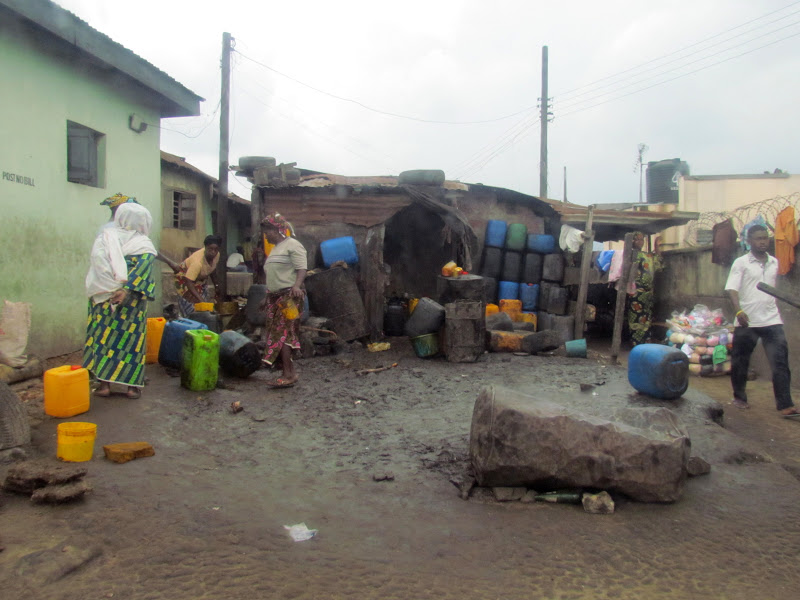
 The roads were tight and crowded and we drove through a lot of very primitive looking and run-down areas. 
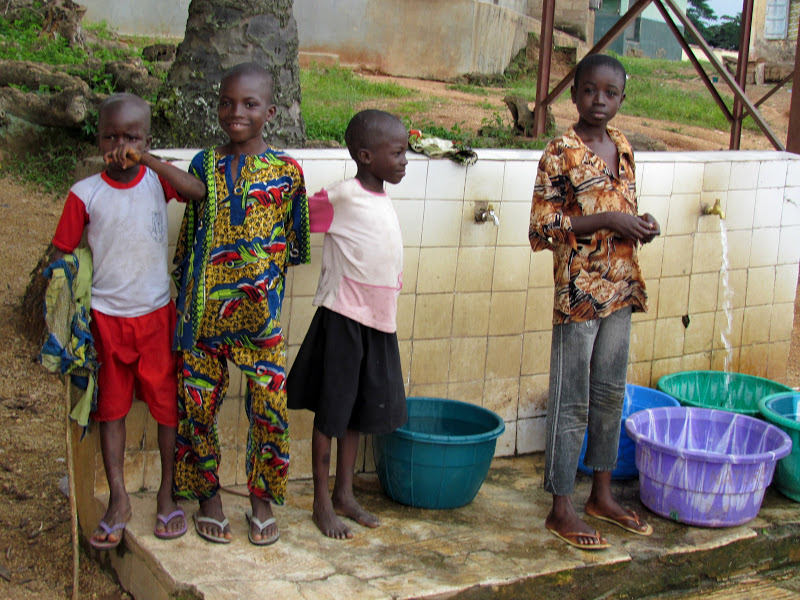
 At one stop we went by boys who were getting water from the local faucet.


Many roundabouts had monumental sculptures surrounded by neglected landscaping.
 

We next visited Bower Tower, a tower built in 1936 to commemorate Captain Bower, the first colonial resident.  It was used for military surveillance.
 
 
The hall next to the tower had some nicely carved wooden doors.

 The tower had a very tight double helix staircase inside.  One side of the helix was for going up and the other for going down.


I forget the name of this church, which was right next to the historic home which was our next stop.

 
We visited Hinderer's House, the home of early missionaries, from around 1853.
Although the home is a heritage site, it's now privately used,
 
and seems to be quite neglected.  I wouldn't want to go up in this shed part hanging off the end of the 2nd floor!
This was an old barracks building next to Hinderer's House.
 
 
I always enjoy seeing the alphabets painted on the walls of schools.  "R" is always for "rat" on these alphabets. That's not the typical choice in alphabets in schools in the US!
We were told that this tree was there before the house was built on this land and they believe it's around 300 years old.  It looked like it was in a lot better shape than a lot of the newer sites in the city.
 
 
There's a lot more to be seen in Ibadan, but that was all we had time to do on a day trip -- the drive home took even longer than the morning drive to Ibadan.  As we left the city there was a downpour and the streets were flooding.  We passed through some very muddy places and saw trucks tipped over on their sides after they had tried to go around traffic jams and didn't stay upright. The traffic on the Ibadan expressway is notoriously awful.  It's always an interesting adventure to get out of Lagos!

Sunday, February 26, 2012

The 290th good thing about Lagos: Experiencing the Eyo Festival

In November these large effigies started appearing around the streets of Lagos, offering a signal that the Eyo Festival would soon take place. 


 This signature masquerade of Lagos Island originated in 1852.  It doesn't occur on a regular basis  -- it was last held in 2009, but the time before that was in 2003.  This is the 83rd occasion of the Eyo play.  It  is held in memory of an important person from Lagos Island who made a significant contribution to the community during his life.  The festival is kind of a funeral rite, but often recognizes someone who passed away a long time ago.  This 83rd Eyo play honored the late Chief Yesufu Abiodun Oniru, who reigned from 1934-1984 -- a 50 year rule!  The program said that he was born in 1864, which made him 120 when he died!  I don't know if his birth date is authenticated, but everyone agrees that he was very long lived.

The Eyo masquerade historically took place on the streets, ending in an open area.  When it was performed in 2009, the decision was made to move the play to the large Tafewa Balewa Square, so more people could watch the spectacle in a more secure environment.  Though we were in Lagos at that time, we were advised by our company security to stay away from the festival, as they were worried about our safety on the streets.  I had friends attend then and they had no problems, and so I jumped at the chance to attend this time, especially after a friend from African Book Group, who is on the organizing committee, got us tickets in the VIP seated area.  I'm so glad I had the chance to experience the Eyo festival, as it is such an interesting peek into the culture of traditional Lagos Island.  This time we didn't even ask the company security people about going, as I didn't want them to warn us against it, we just made plans to attend.  There were a couple of moments entering and leaving the stadium when we worried about our safety, but most of the time we were up high above the action in comfortable, covered seating, with waiters bringing us food and drink.  We also got a gift bag with a historical book and program to the festival, a souvenir polo shirt and DVD with a documentary history of the festival.  

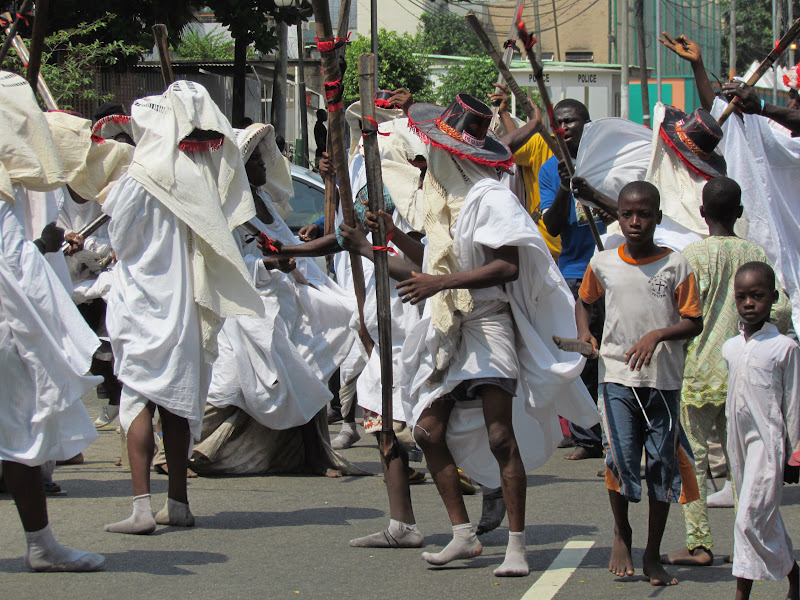
 Approaching the stadium, there were various groups of Eyo figures gathering outside. The Eyos are symbolic representations of spirits come to cleanse the streets of Lagos.  The Aropale wrapper which covers the figure, drags along behind the figure, sweeping the streets.  The Eyo had been up all night symbolically purifying the city.  In reality, I'm sure many were drinking and partying, as the signs were already in evidence.  We saw some roughing up by some of these undisciplined groups.  There are different levels of Eyo groups -- some are more prestigious than others.  But when we passed by them, we were instructed to show respect by removing our shoes.  The staffs they carry, called opambata, have markings that are mostly blessings.  The Eyos can bless the passers-by with a touch of the opambata, or if they sense disrespect, they will strike you.  As we neared the stadium, we saw someone getting pretty soundly beaten by an Eyo. 
 But the Eyos I met at first were anxious to pose for pictures and glad that oyibos were coming to experience the festival.
 This a little child Eyo dressed up for the occasion. 
 Inside the stadium we were seated opposite the seating of the royal Oniru family, relatives of the honoree.  They were dressed for the occasion, many with matching outfits.  I'm sure it was very special for them to see their relative so honored. 

They did a lot of posing for pictures.

 In preparation for this event, someone had designed fabrics for the occasion with the name and picture of Chief Oniru.  There was a great variety of clothing for men and women made out of this fabric.


Events that were part of the festival had taken place over the prior few days, but we were there for the final culmination of the festival with the arrival of the Eyo groups in the square. 

We did a lot of people watching and visiting with friends.  Here's some of my book group friends in the stands.  In front is Aduke, who got us the VIP seats.  Many thanks, Aduke!

The action itself wasn't anything super exciting, but a long parade as the Eyos arrived and processed in with music and dancing. There were lots of groups with different looks and colorful touches.


 There was a great stir with the arrival of the Oba (traditional ruler) of Lagos:  His Royal Majesty Oba Rilwanu Osuolala Babatunde Aremu Akolu I.  He arrived in a motorcade and in the photo you see the umbrella out ready to cover him as he leaves the car.  The umbrella is a symbol of respect for the chief.  The photographers were crowding around to record his arrival.


The Eyo figures are known for their high leaping.  I had thought it was pretty amazing that they could jump high with their long draping robes.  I didn't witness any super high leaps as I had seen previously in pictures, but here's a video with some jumping.


 This guy on stilts was pretty talented.


After the "ordinary" Eyo groups processed into the stadium, it was announced that the more prestigious groups, the Orisha groups, would come in and, as a sign of respect, no photography would be allowed.  It was pretty amazing to me that, as predatory as photographers can be in this country, they did actually put down their cameras.  I put my camera down around my neck, but people motioned me to put it away in my bag.  I saw several people get into trouble when they made motions toward their camera.  So the most interesting part of the program I couldn't capture with photos.  They carried in an enclosure made from mats, called a Para, which holds a symbolic corpse of the honoree.  He was lying in state for several days prior to the festival and is paraded in with the Orisha groups.

The governor of Lagos State, Governor Fashola walked into the stadium (in contrast to the long motorcade used by Oba), wearing a white robe and the traditional hat, called an Aga, and he addressed the crowd.


 When we left the stadium, we were met by a musical group, who played for us, undoubtedly expecting some monetary reward.  They were disappointed, as we had purposely not brought any cash with us that day. 
 We passed many Eyo groups who had left and were partying in the streets. Most were polite and willing to pose for a picture.  Even though I had removed my shoes and was showing, I thought, the proper respect, I did get a pretty sound swat on my back from one of the Eyos.  I think he was taking advantage of the opportunity to hit the oyibo.  But I got more blessings than hits from the Opumbata that day.  The hit I received didn't really leave a bruise, but cemented a solid memory of our day at the Eyo Festival.  It was something I will never forget!