Showing posts with label arts and crafts. Show all posts

Thursday, October 25, 2012

The 329th good thing about Lagos: quilting time

I've had a fun time in Lagos learning about quilting.  I've been a part of a fun quilting group and we've had some expert quilters who have shared their expertise with many of us beginners.  I love the vibrancy of African fabrics and I've enjoyed using them in some pretty wild quilts.  I'm definitely not into traditional quilts.   Here's pictures from some of the quilts I've worked on during my time here.
 
This one is a baby quilt that I made for Natalie, my granddaughter.
This quilt is from a pattern called the "Steps to Freedom."  It's one that many of us in the quilting group have made.  It's a relatively simply pattern and it's a fun, scrappy quilt which showcases a variety of fabrics.  We share fabric scraps in the group so we can get a good variety of fabrics for this quilt.

I made some quilts using blue fabrics for presents for two grandsons.  They're pretty wide and crazy.

My daughter-in-law is as new as I am to quilting, but she has a real gift both for composing and creating quilts.  My quilts are amateurish compared to hers.  She also was really productive, at least until the baby she's holding in this picture (my youngest grandson, Mason) got mobile.  And she has 4 young children!  I couldn't believe how many beautiful quilts she was able to finish.  She was very nice to quilt these two large blue quilts on her mom's long arm quilting machine.
My latest quilt, which I finished piecing over the summer is one called a "stack and whack" or a "one block wonder" quilt.  The quilt top is made from using just one fabric, but the pattern is made from how that fabric is cut and put back together.  The quilt top is composed of hexagons made up of triangles that are exactly the same pattern, cut from stacking 6 pieces of fabric on top of each other.  Because the triangles have sides of equal length, each hexagon can have 3 possible variations depending on when corner is in the center. 
The the hexagons are organized into whatever seems to be a pleasing pattern.  This next photo is the hexes arranged on a "design wall."  When they are sewn together, it is done with half hexes sewn in strips, so that part isn't as hard as it may look.   I loved doing this quilt.  It looks like a kaleidescope.  It also wasn't that difficult, though it looks pretty complicated.
I used some of the original fabric around the border of the quilt on the top.


And I also used the original fabric, with some yellow border fabric on the back, so you could see what the fabric looked like in the original state.  My daughter-in-law is also going to quilt this one for me.  I'm excited to see what the finished quilt will look like!
 

Tuesday, October 23, 2012

The 327th good thing about Lagos: a nice guy making good ceramics

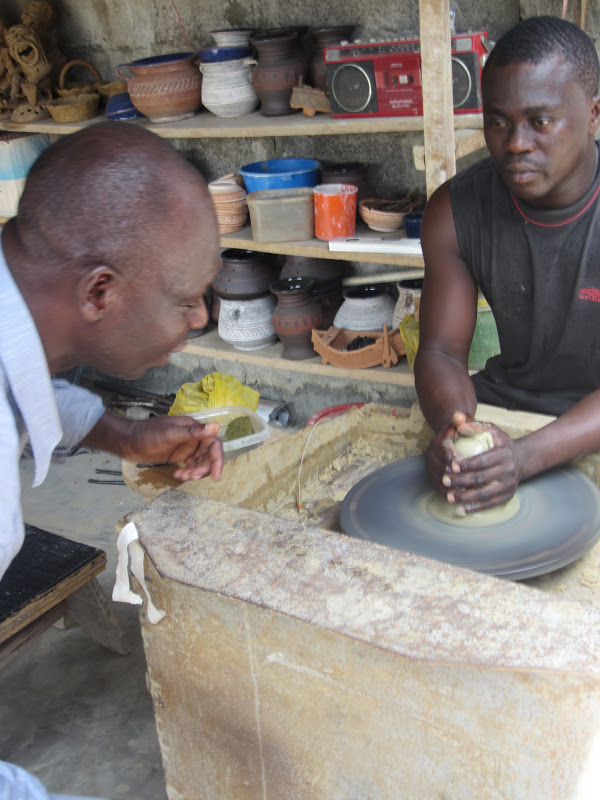
Charles is a potter who is enjoyed and supported by many of the expatriate women in Lagos.  He's from Ghana and got a leg up on his business by the American Women's Club and by some expat women individually.  I don't know if they still do, but I know women who have shipped in materials for his glazes when he couldn't get what he needed here.  He's a nice guy who really appreciates and recognizes the help and his business has grown into quite a good enterprise.  I stopped by his place of business one day to pick up some pots that I had asked him to make for me and he gave me and my driver a demonstration of his work.  He's also started doing classes for people to come and try their own hand at making a pot. 
 
I've always been amazed at how easy potters make it seem to build a smooth pot on a wheel.  I've tried it and it really isn't very easy.


He also has someone now who is making glass beads for jewelry and the decorative strands they have here.  It was interesting to see how these are made, because I certainly have been an regular customer of glass beads here.


 Here's his little shop.  He makes pots large and small and lamps and dishes -- decorative as well as functional items.  He really does quality work.  He makes dishes with green glaze or a beautiful dark blue glaze.  When I'm buying for myself, I get the green glaze. 


Here's some examples of things I've bought from him.  I asked him to make the berry bowl for me, as I saw one in the States and I thought it was nice, to have a bowl with holes so berries could breathe and not get moldy.  I don't have fresh berries much here, but I thought it would be useful back in the States.  The little shallow bowl is a nice size for a dessert dish.  Some of his dishes are glazed on the outside and some are left unglazed, but decorated with designs.  If any of my US friends are interested in getting some of Charles' pottery, let me know what you want and I will bring it back for you when I come at Christmas.  His ceramics are quite reasonably priced, and I'd love to give him more business.


Monday, October 22, 2012

The 324th good thing about Lagos: artists focusing on the issue of water

Last spring I went to a very interesting and unusual musical performance and photography and art exhibit which had been travelling to many venues in the country.  It was titled "Water No Get Enemy" after a famous Fela Kuti song.  Fela is probably the most famous Nigerian musical performer and was a pioneer of Afrobeat music.  But the exhibit really didn't have anything to do with him -- they just used the title of his song as a title and theme.  The organizers of this exhibition wanted to generate a consciousness about water and the problems of water supply and usage now and in the future.  The availability of a clean water supply is a huge problem in Nigeria, especially in the overpopulated metropolis of Lagos.  The infrastructure is not there to supply many in the population with running water at all -- many people are forced to buy jerry cans of water from sellers on the streets who pull them loaded in trailers.  And, of course, that water is just for cleaning.  We all have to buy purified water for drinking and cooking.  Many Nigerians buy plastic bags of water for drinking, while those with more means buy water in bottles, large and small.  Of course, this creates a huge increase of waste from all these bottles too.  Anyway, they had this exhibit of art with water as the focus and the concert I attended  was really wonderful.  It featured a Dutch pianist, Marcel Worms, who chose piano works of many styles and periods, that were composed with water as an inspiration.  He performed these works while a slide show of water photos were scrolling on a nearby screen.  It wasn't a super high-tech display -- that doesn't happen much in Lagos -- but it was still effective.  He spoke a bit to help interpret the works he would play.


Of course, I live a life of privilege in Lagos, but we still have issues with water.  Bad plumbing causes many breaks and ensuing floods.  Our water out of the tap is often brownish or heavily chlorinated, so I sometimes cringe to even wash with it.  And now and then, often with no explanation, we have no water coming out of the taps at all.  But for the most part, we have bottled water deliveries that take care of our need for purified water and I can use that for a sponge bath if my faucets are dry.  We are blessed to be spared the problems that many of the Nigerian poor deal with daily.  I remember when I was doing interviews for the AWC scholarship program and a college student was telling about the overcrowding in the hostel she lived in (what we in the States refer to as a dorm room).  She talked about how often the other girls in her room would use her bucket.  This bucket of water was what she used to wash with each day.  I'm sure college students in the USA would have a very difficult time adapting to those living conditions.  And I know in rural areas access to clean water is often a very troublesome issue.  I know it takes more than artists raising consciousness to deal with these issues.  I hope government officials are watching and will start working to address these challenges.

Saturday, October 06, 2012

The 320th good thing about Lagos: visiting a master's studio

Bruce Onobrakpeya is probably the most celebrated living Nigerian artist, and likely one of the best known and respected in all of West Africa.  So I jumped at the chance to visit his studio when the outing was organized by the Nigerian Field Society last spring.   Meeting Bruce and hearing him speak of his life and his artistic philosophy was a wonderful opportunity.  He was very generous with his time and the access he gave us to his studio.

 Bruce's son Mudi welcomed us as well.  They were getting ready to ship many artworks to Dakar, Senegal for an international exhibition.


Bruce just turned 80 years old, but he seems much younger, mentally and physically.


 Above is one of his prints that he was going to bring to Senegal.  Many of his very famous works are sculptural relief works similar to the one below.


The bottom floor of his house was chock full of works by Bruce, as well as cultural objects that possibly he uses as inspiration in his artwork.


 We would have loved to buy one of his works out of his home, but they're pretty pricey, and this visit wasn't really intended for shopping.

 Quite a variety of objects in every corner.
 
Bruce gave us a catalog from one of his previous Harmattan workshops.  His foundation runs a workshop in Delta State where each summer artists come to study and work together, learning from formal presentations as well as from creative collaborations.  Onobrakpeye is an artist who gives back to others -- he has contributed much to the development of art and artists in Nigeria.


Lots of art on the stairs up to his workplace on the top floor.


The studio area upstairs is a jumble of art tools and materials, old works, works in progress, pieces from old prints, drawings, casts from relief works.  He uses many varied techniques in creating his art, and the studio reflects the array of different materials.
 a printing press

 lots of  areas just looked like an artist's still life....


 Onobrakpeye actually developed many innovative printmaking and sculptural relief techniques, requiring a variety of tools, chemicals and materials.


Group picture at the end of the visit.  Thank you Bruce and Mudi!  It was great to see where the master does his work!

Sunday, March 18, 2012

The 308th good thing about Lagos: a visit to an incredible collection of Nigerian art

I was very excited to finally have the opportunity to visit Prince Shyllon's art collection!  Since I first heard about his extensive collection -- the largest private collection of Nigerian art -- I was hoping to have the opportunity to visit his home and see the collection first hand.  In 2007, Prince Shyllon founded his art foundation, OYASAF, which promotes Nigerian art and artists.  In addition to collecting art, he funds study grants for scholars to come to Nigeria to study various subjects relating to the arts.  I had met Shyllon and his lovely wife before and heard them speak about their collection, but it was a real treat to be able to visit and see his collection with a group of members of the Nigerian Field Society. 

We first had a seat in a small reception room where we saw a power point presentation about his foundation and collection and were able to ask some questions to our host.  Shyllon started collecting art when he was a student at the University of Ibadan.  One thing I found interesting -- he said that he had decided early on to divide his life into three periods -- Education, Labor and Living.  He had gotten a good education, then made a substantial fortune in careers in the financial and legal worlds, and was now into the "living" portion of his life plan.  He is a man with a passion for art and collection and a generous laugh.

We were greeted by a whole bunch of crowned cranes that populate his beautiful sculpture garden.  He has a great variety of birds of many kinds in the garden -- and even other animals, including a porcupine.


 He said he is a sculpture man -- preferring sculpture to painting.  His garden was crowded with a great variety of sculpture.  Notice these hard hat wearing workers on the balcony?


As we entered from the road, he pointed out the sculptural people that were taking notice of our arrival. 
 Then there is a sculpture of a woman bearing kola nuts to welcome us.

And, lest we get too comfortable, there were also an armed sculpture guard by the entrance gate giving warning.
This is the artist, Adeola Balogun, next to his very beautiful bull sculpture, which is bronze with a body made of woven rubber from tires.


 There were a number of sculptures of Eyo figures.
 Another guard on the roof of a wing of the house.
 He said this figure on the balcony represented his grandfather.
 Unfortunately, we weren't allowed to take pictures inside the house.  Seeing the interior was an amazing experience.  Almost every inch of space was covered with art.  There were narrow passageways to walk between the art pieces in each room.  He said he counted his collection several years ago at over 6000 pieces, but I'm sure he has many more now.  He said he probably averages an acquisition of a piece a week.  I know some pieces in his collection are by artists whose work fetches big sums at auction. But it seems like, at least in some periods of his collecting history, he was going more for quantity than quality.   He made mention of trying to fill gaps in his collection with his current acquisitions. He will selectively sell pieces as he needs to fund his foundation, but it seems that he's still trying to grow the collection rather than refine it.

 Furniture seems to be an afterthought in his house.  Walls were mostly brightly painted, but there was never much wall visible between the art works.  He kept opening the doors to bathrooms saying that they also had art displays.  He had a wonderful and extensive study library.  There was sculpture of all mediums, paintings, folk and historic works, Nigerian art old and new. There were a couple of "theme" rooms -- works by a particular artist or style, but mostly works seemed to be displayed randomly.   His wife is very supportive and understanding, I know -- she would have to be.  I certainly couldn't live in that environment - - it was so crowded and visually stimulating, I could never relax.  The house would make an incredible museum, and he hopes to make it one someday.  It would be great to allow more people to see the amazing collection of art he has accumulated.  He would like to allow some of the art from his collection to travel to museums in an exhibition, and he said there is a museum scholar who is hoping to organize an exhibition. 

There's  more sculpture in his back yard pool garden.


 Before treating us to some "small chop" on his terrace, he showed us one of his 5 storage buildings he uses to store art he has no room for in his home.  I was a little worried when I saw all the art in this building which had windows open to the elements.  Certainly in the storage areas of most art collections, there are measures taken to keep the works at consistent levels of temperature and humidity.  I think there may be great conservation issues with his paintings and other art works if they are kept in Nigeria's heat and humidity, along with dust and insects.  As we toured through his very large home, he would turn on room air conditioners as we entered each room, so works inside also aren't in a temperature controlled environment.  And someone later remarked that he only saw one fire extinguisher in evidence as we visited his house.  I certainly hope that Shyllon never faces a fire -- Nigeria would lose some real treasures.


Thank you, Prince Shyllon, for making such an incredible commitment to the collection and promotion of Nigerian art and artists!  And thank you for welcoming us and letting us get a peek at your passion!  Nigerian art is vibrant and exciting and there is so much talent in this country.  Shyllon knows it and hopes that someday the world will also know.

You can read more about our visit and Prince Shyllon and his collection here at a blog post done by a friend who is a very good writer.  She writes an interesting blog about cultural issues in Nigeria.