Saturday, February 14, 2009

The 159th good thing about Lagos: rescuers in pirogues

We're stuck at home without a driver on Valentine's Day (sigh, no date to the movies as we had planned). Sometimes the constraints of life here are depressing. But I'm finally getting around to blogging about our fun outing to the beach on last Saturday. We were invited by a co-worker who is a Total employee (the French oil company that is one of the partners in the project) to go with them to Total's beach complex. A trip to the beach is always a really great get-away here. It's wonderful to get away from the noise and bustle of the city and I find the beach sounds and air very soul-restoring. Total has a wonderful beach complex, with a beautiful pool and comfortable lounge chairs and they fix visitors a nice barbeque dinner and everything. It was a really great day.


We had a bit of an adventure getting to land, as the boat transporting us got stranded on a sandbar as we neared the dock. (We travel to the beach on an inland waterway and walk across a narrow peninsula to the beachhouse on the ocean beach area.) The boat driver tried to get the engine free and only succeeded in getting the propeller further mired down. So the locals came out with their pirogues and ferryed our group into the dock. It was a little nervewracking, as the canoes were quite unsteady. I was sure we were going to tip over and my camera would be destroyed. Of course, I was more worried about the baby in the car seat and her 4-year old sister who were also on our canoe. Gratefully, we made it to shore without incident. But it's made me a little more worried about the outing we will soon take to a remote village festival where we have an hour on a pirogue ride. I'm going to put the camera in a zip-lock bag and hope for the best.


Down the beach a bit from the Total complex were the ruins of a couple of ships. These were different shipwrecks from our first visit to a shipwreck site in Nigeria.
As I looked at these rusting hulls and recalled all the other broken down ships in the water we passed around the port on the ride to the beach area, it made me frustrated that no one comes and cleans up their own mess. I would think that with the price of iron that the salvage costs might come with some reward. I wish boat owners would be required to get rid of their broken-down ships. Our boat was very quickly freed from the sand undamaged after the load was lightened when the passengers were ferryed to shore. I've found a lot of good things in Nigeria. But I really wish they would start the good thing of cleaning up their garbage!

Sunday, February 01, 2009

The 158th good thing about Lagos: National service by college graduates

On Saturday I participated in interviews for returning American Women's Club scholarship students. I was teamed up interviewing a student with an American woman who is here married to a Nigerian. We got into a discussion about NYSC, the Nigerian Youth Service Corps. I had heard a little bit before about this mandatory youth service that is given by all students who have been able to graduate from college. After our discussion I spent some time learning more about this program on the internet (one reason I am addicted to the internet -- not just quick and easy communication, but readily available information!) This program was initiated in Nigeria in 1973. Upon college graduation, all Nigerians are required to perform a year of service to their country. Even if a student travels abroad to study and then works abroad, if they return to work in Nigeria (even if they are much older), they are obligated to first give a year of service to their country. The program was quite highly praised in the information I found about it on the internet.

The program's objective (in two very long sentences!) is "to raise the moral tone of our youths by giving them the opportunity to learn about higher ideals of national achievement and social and cultural improvement to develop in our youths attitudes of mind acquired through shared experience and suitable training which will make them more amenable to mobilisation in the national interest; to develop common ties among our youths and promote national unity by ensuring that: as far as possible, youths are assigned to jobs in states other than their states of origin and away from their geographical, ethnic and cultural backgrounds.... Each group, assigned to work together, is as representative of the country as possible; the youths are exposed to the modes of living of the people in different parts of the country with a view to removing prejudices, eliminating ignorance and confirming at first hand the many similarities among Nigerians of all ethnic groups; to encourage members of the Corps to seek, at the end of their corps service, career employment all over the country, thus promoting the free movement of labour; to induce employers, partly through their experience with corps members, to employ more readily qualified Nigerians irrespective of their states of origin; and, to enable our youths to acquire the spirit of self reliance."

When graduates report for their year of service, they first attend a 3-week long kind of boot camp where they go through some physical training along with program training. They then receive their assignment. One article said that "The National Youth Service Corps takes care to avoid posting that results in wastage of human resources. Corps members are therefore, as much as possible, posted to areas relevant to their disciplines although sometimes national need may override this consideration."

The service year sees the Corps members serving in such areas as "hospitals, road construction, farming, water schemes, surveying and mapping, social and economic services, teaching, food storage and eradication of pests, rehabilitation of destitutes and the disabled, development of sports, service in all government departments and statutory corporations suitable for new graduates, development projects of local councils, the private sectors of the Nigerian economy and such undertakings and projects as the Government may by order determine." Businesses and charity organizations can apply to receive Corps members to work for them for a year. The organizations pay no salary, but all Corps members receive a stipend from the government which currently amounts to a paltry 9000 naira a month (at the recently devalued rate of around $60)! I know there are people here that live on that, but I sure don't know how they do it. So, it's almost an unpaid internship.

At the end of the year, the Corps members go through a "winding-up exercise" which gives them the opportunity to review their year and what they've gained from the experience and make plans to go forward with their lives. I learned from our discussion at the interview that many participants developed close friendships through the program, especially during the "boot camp" orientation weeks. Some postings result in full-time employment. I'm sure that in many instances it's a valuable character building exercise and hopefully it achieves its aims of helping the country while instilling in college graduates a spirit of selfless service to their country. That's a good thing in Nigeria that I can't see ever happening in the United States, though our country would undoubtedly be better for it.

The 157th good thing about Lagos: Returning after a long holiday feels like coming home.

Well, it's been a long time since I've updated my blog. Too much happening during the holidays to worry about blogging. And it's sometimes difficult to focus on good things in Lagos when I'm enjoying being away from the place. I returned to Lagos Friday night after a very smooth trip and was frustrated to find that the internet was still out at the apartment due to a strike. We went in to the office to use their internet on Saturday, where they had a backup server working and then -- Hooray! -- this afternoon it worked spontaneously at home. What a nice surprise, because, you know, I get quite tense when I have no way to get on the internet. I freely admit I'm addicted.

It actually feels pretty good to be back in Lagos, and I really enjoyed seeing old friends and meeting some new expats at church today. It almost seems like I haven't been gone at all, though it's been 7 weeks. In that time, we had a great Christmas, and enjoyed time spent with children, grandchildren, parents, and also a visit by my brother and the 5 beautiful women in his life (no, he's no polygamist, he's married and has 4 daughters)


Then, after the holidays, I took a trip to Boston to help our daughter welcome a new grandson into the world. The timing worked out perfectly -- I was there a week before he was born, which was enough time for Spencer, the almost 2-year old to get comfortable with Grandma. Austin David was born 5 days late, but healthy and perfect at 8 lbs. 7 oz.
Then I stayed for 2 weeks after the birth, giving some extra attention to Spencer and (I think) providing some helpful service around their home. I know I loved being there and getting to know my grandsons a little better and also getting a good taste of winter while there. We had quite a cold spell and a lot of snow while I was there. It was really fun!
It is really special to be around a spirit so new to the world. New babies are just so wonderful and I really miss cuddling Austin and playing with Spencer, who is a lot of fun, and looked pretty happy here as we watched the inauguration of President Obama. I'm hopeful for a fresh beginning of a new administration in the United States, which is ready for a change of leadership. Let's all hope and pray for wise decisions by leaders that will bring hope for a great future for the next generation.

Monday, December 08, 2008

The 156th good things about Lagos: Nuns caring about empowerment for women

The thing I most appreciate about my charity responsibilities with the American Women's Club is getting acquainted with people who are devoting their lives to doing good things. It makes me realize how self-centered my life is and how feeble my little attempts to serve and contribute. Monday I went to visit the Cardoso Catholic Community Project -- a charity with which the club has a long history of support. We had lost connection with them this past year when their contact person with the club left Lagos, so Sister Bernadette was very glad to hear from someone from the American Women's Club and was happy to receive some Christmas gift bags and money to help with their children's Christmas party.


It was a treat to meet and visit with Sister Bernadette. She is warm and thoughtful and also very educated. She lived in California for 6 years, getting two Masters degrees and a doctorate at Berkeley in areas of theological studies. As we toured Cardoso, she reached out to greet and visit with the people around her. Her caring for them was evident.

It was a Muslim holiday, so much of the center was quiet, but we enjoyed getting a look at some of the many good works they do there. There are seven nuns in the convent here at this center, which is supported by St. Mary's Catholic Church. They have a staff of around 100 helping them with their works, with the main purpose of empowering women to improve their lives.

The clinic was open on the holiday -- the nuns and staff work 6 days a week at the clinic, and on Sunday the nuns are busy with the work of the church, so they don't get a lot of down time.

This waiting area is often full of people, they said. They see 70-100 people a day. They have ante-natal care and training, they give immunizations, and provide all kinds of health services for the local community. They also have feeding times for malnourished children. People pay what they can for their services.


This is the staff of the lab, where they have some pretty good equipment. They do their own disease testing. They will do HIV testing upon request and give counseling and direct those testing positive to government centers where they can get free drug therapy.


The pharmacy was not really well-stocked, but better than in many charity clinics I've seen here. The clinic overall was very impressive (considering the Nigerian standard) in their facilities.


While we were visiting the clinic and meeting the nuns working there, the noon bell rang and the sisters explained that it was a reminder for them to stop their work and invite everyone in the center to join them in prayer. It was sweet to see their devotion and be a part of their group prayer -- just as visiting the Muslim world last week with their regular calls to prayer, it was a reminder to me of the importance of regular connection to God through prayer.

Education is a central focus to the Cardoso mission. They have schools ranging from pre-school through adult education. They were all quiet on this holiday. The buildings all looked very well cared-for.


Sister Bernadette said that often this library is filled with members of the community enjoying a place to read.


They are expanding their secondary school and are in the process of building and equipping their science lab. They are hoping to receive donated funds to allow them to finish these rooms and provide materials so they can properly teach the sciences.


Sister Bernadette said the secondary classrooms are also used for adult education in the evenings. But a central focus of their education is with women's training classes. They just had a graduation ceremony (their women's training educational year runs with the calendar year) where 100 women graduated from their program. They run a two-year program which trains women in various areas to prepare them for meaningful employment or with skills allowing them to start their own businesses. They teach tailoring skills, cake decorating, hotel management, English, and a number of other classes.


To travel to Cardoso, we were glad to drive on highways more passable because of the Muslim holiday, and as we neared the church compound, we passed through a busy market area teeming with activity. The mass of humanity and need here in Lagos is overwhelming at times, but it's rewarding to visit places like Cardoso where they are making a great contribution in making better the lives of many Nigerians.

Saturday, December 06, 2008

The 155th good thing about Lagos: Twins are special

This past year I know a number of mothers who have given birth to twins, so I was especially interested at a lecture I attended this past week at the National Museum. The lecture was on the Ere-Ibeji, the twin figures, of the Yoruba. The predominant tribe here in Lagos is the Yoruba, and I knew of their high rates of twin births -- one of the highest rates in the world. I was familiar with Ibeji figures, there are some of them in the Museum of Fine Arts in Houston and I had seen them other museums; the curator here said they have around 7,000 ere-ibeji in the museum collection here (though only a few on display at any time).

In ancient times, twins were considered subhuman and there was a practice of infanticide among twins in the Yoruba land. This practice was changed, one tradition says, because some parents consulted an oracle after a series of mysterious deaths among their children, and the oracle said the deaths were occurring because of their practice of killing twins. He told the people to stop killing twins and honor them. By the 18th century this developed into a practice of twin worship among the Yoruba. Twins get extra attention -- their mothers will carry the twins to the market to dance in their honor, sing their praises, and get gifts from passersby. So the coming of twins is associated with a rise in the fortune of the family and there is rejoicing. At the lecture, one of the museum staffers sang and danced a traditional song of a mother of twins. She sang, "I am not afraid, I am not afraid of giving birth to twins. There is palm oil, there are beans." It is believed that the best food for twins is palm oil and beans because these bland foods are thought to cool their spirited temperaments. The mother of twins, known as "Iya-ibeji" is given special honor.

One thing I found very interesting is their belief about who is the older and younger of the twins. Traditionally the first born twin, regardless of sex, is considered the younger of the two, and is named Taiwo, meaning "comes-to-taste-life." The second born is Kehinde, which means "comes-last." Kehinde is considered the eldest twin who sends Taiwo first to see if the world is a good place to live.

Because twins are usually born pre-term and often smaller than single birth infants, there is a high death rate among twins. If one or both of the twins were to die, the parents commission a carver to make an ere-ibeji. "Ere" means image and "ibeji" means twin -- so this is an image of a twin that is carved to take the place of the dead infant. These figures are only carved if a twin dies, it is not made at the death of a single-birth infant. The ibeji figure is believed to house the spirit of the dead twin that was divided in two at the birth of the twins. The carver is given free rein to carve the figure as he wishes and the twin figures, though usually carved for the death of infants, are most often depicted in the fullness of life. The ere-ibeji is given ritual care -- rubbed with oils and sugar cane and sometimes dressed and given food as if it were living. It is often carried by the mother in her clothing wrapper as she would carry a living baby. The Yoruba traditionally believe that if a twin that dies is not remembered by the carving of an image, this slighted twin will trouble the surviving one. If both twins die and are not properly remembered, the mother will have difficulty with conception and other misfortunes such as sudden poverty, destruction of property or persistent sickness may befall the family.


I asked the curator why, with the importance of the ere-ibeji to a family, there are so many ibeji figures in the museum and available for sale at the market. She said that with the influences of Christianity and Islam and with Western influences moving the Yoruba away from native religion, there is less respect in the culture for ibeji figures. Where they once would have been kept and tended for generations, now they are seen as something valuable to sell. Of course, there are also many at the markets that are represented as true ere-ibeji, but are newly made for the market.

I enjoy seeing the differences in styles of the various ere-ibeji, but it is kind of sobering to realize that each one represents a child who has died.


Friday, December 05, 2008

The 154th good thing about Lagos: Lots of help assembling Christmas gifts for charities

I have just over a week in Lagos between our return from our trip to Egypt and my flight back to the States for the holidays. My biggest project during this week was to complete the assembling of holiday gift bags for the staff of the charities that the American Women's Club supports. Last year I assisted with this project, and this year I was in charge. We needed 88 bags and had requested donations of money and goods from club members to stock the bags. I had wonderful assistance purchasing goods from wholesale dealers and we were allowed use of a company's guest house to assemble the bags. After our arrival home from the trip on Sunday, on Monday shoppers went out with the funds we had collected and Tuesday we had a team at the guest house assembling the bags. We distributed the bulk goods in ziplock bags and set up an assembly line, and with all the willing helpers, we had 88 assembled gift bags in no time. Each bag held rice, white and yellow garri, beans, evaporated milk, powdered milk, candles, matches, tea, vegetable oil, maggi cubes (bouillon), salt, sugar, tomato paste, toilet paper, sardines, semovita, pasta, a pen or pencil and an airplane bag stocked with toiletries. No luxuries, but some neccessities that will undoubtedly be useful and appreciated.


I'm still working on distribution -- I have a lot of help with that, but I'm delivering bags to a couple of charities myself. Today I faced some horrible traffic (well, my driver faced it -- admittedly I sat in the back seat with a book and my i-pod -- but it was still aggravating) bringing some gift bags and christmas party money to an orphanage -- but I was rewarded with a crowd of cute little kids who wanted to hold my hand and get some of my attention.

The 153rd good thing about Lagos: a chance to visit a very different African country, with a bonus look at a former home

One big perk about living in Lagos is our R&R trips out of the country. The company covers our airfare and gives us a per diem that doesn't cover our costs, but helps with the expense of the trip. Our university student son really enjoys having them pay for his travel to meet us twice a year. He doesn't have a lot of free time, but he was willing to miss some school around his Thanksgiving break if it meant a trip to a new place. Last Thanksgiving we had a wonderful time in Madeira, and this year we chose to travel to Egypt, via Dubai. We had lived in Dubai from 1990-1992, before it started to boom. Our son, Jordan, was just 6 years old when we left. Jordan and the emirate had both grown tremendously since they were last together. We just stayed there for one night and had a day and a half to look the place over.

This road with the skyscrapers was nothing but desert emptiness when we lived there. Now it's this huge busy highway lined with very tall buildings.


That's the Burj Dubai, which will be the tallest building in the world in the background of this next picture. In the foreground is the demolition of the neighborhood club and swimming pool which was across the street from the villa where we lived in Dubai. We also came in time to see the demolition of our former home and the neighborhood by the American school where many of our friends lived. Who knows what will be built in their place.

After our nostalgia tour of our previous home and the school, we visited some malls -- one famous one with a ski slope inside. I enjoyed even more the visits to the old shopping areas of Dubai -- the spice souk, where I replenished my supply of frankincense and myrhh, and the gold souk where we looked, but didn't buy a thing.


We enjoyed taking an abra, a water taxi across the creek to the souks. It was about the only cheap thing in Dubai, costing only a dirham -- about a quarter, to get to the other side of the creek.


Dubai is a playground for the very rich. I am very glad that we lived there back before it became what it is now.

From the old alongside the very new in Dubai, we traveled to Egypt, where old takes on another dimension.

We visited pyramids, this step pyramid in Saqqara (outside Cairo, near the ancient Egyptian capital of Memphis) is the earliest pyramid constructed, designed by the innovative architect Imhotep in the 27th century BC.


Of course we also saw the most famous pyramids in Giza, which we could see from our hotel window. I was amazed at how close they were to the city.


We rode a camel,


and saw the Sphinx.


We took a sleeper train to Aswan and spent the day down there (though it's south, it's called "Upper Egypt") sightseeing. We saw the great Aswan and the High dam that have regulated the flow of the Nile and then took a boat to visit the temple complex of Philae, which was relocated to a higher island in the 70s after it was flooded after construction of the High Dam. UNESCO relocated 24 monuments in Egypt and the Sudan that would have been lost under Lake Nasser with the construction of the High Dam. Philae is a beautiful complex and it was awesome to contemplate not only the initial construction of the buildings, but also to wonder how they were able to move the whole thing.


We then went on to Luxor, where we visited some tombs in the barren Valley of the Kings, where King Tut's tomb was found, along with over 60 other tombs, and undoubtedly more still undiscovered. They are still doing lots of excavation and exploration here.


We visited the amazing Temple of Hatshepsut, built against a high cliff. She was a female Pharoah, who reigned in the mid 1400's BC. She was a strong woman who wanted to be pictured as a male so noone would question her strength.


On Thanksgiving Day we got an early start and got to be one of the first of the day in to visit the beautiful temple of Karnak. It was lovely to see the huge pillars and tour enormous complex in stillness in the early morning light.


We then visited the Temple of Luxor,


ate Thanksgiving dinner on the banks of the Nile (no turkey) and took an afternoon ride on a felucca, before catching the sleeper train back to Cairo.

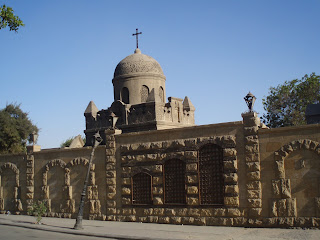
Back in Cairo, we enjoyed seeing the fabulous Egyptian Museum with loads of fantastic ancient treasure. We visited Coptic churchs,


and mosques with beautiful interiors,


and a minaret to climb with a panoramic view of Cairo.


We were very blessed to have a safe journey and all returned to our destinations without any disruption or problem. I had heard a lot about the poverty of Egypt but I'm sure I saw it with very different eyes than I would have had I not been living in Nigeria. It actually looked quite clean and functional in comparison. The trip was a wonderful break from the very real pressures of life in Lagos.