Every other Easter weekend we've lived in Nigeria, we've made use of the long weekend and traveled somewhere. I was feeling pretty deprived that it wasn't going to work out to get away this year. But then the weekend shaped up beautifully with some day trips and I was glad that I was in town. On Friday a friend organized an outing to the village of Ibeju where she had a contact who organized canoe trips on the waterways around the Lekki peninsula. We had gone on a canoe trip before, but this was in a slightly different place, and though there were many similarities, our village visit on this trip didn't come with a masquerade performance. But it was still a thoroughly delightful and relaxing day and it was so nice to get out of the city and enjoy nature. We drove out Lekki peninsula for about an hour and parked the cars near this big tree which seemed to be a nice meeting place for the men of Ibeju.
 We were greeted enthusiastically by the children of Ibeju, who crowded around and loved to have their picture taken.


 I decided to "hold it" rather than take advantage of the toilet facilities that were offered us. Although private (if someone was holding the cloth over the doorway), there wasn't even a hole in the shelter -- just a crack in the concrete, and you would be dodging everyone else's splashes.
 When we walked through the village to the waterside to get the canoes, the children followed and several grabbed Brent's hand. This has happened before and it always surprises me, because it seems like most children in the States are scared of him -- probably because he's such a big guy -- but African kids seem to warm right up to him. None grabbed my hand, but maybe that's because I was busy using the camera.
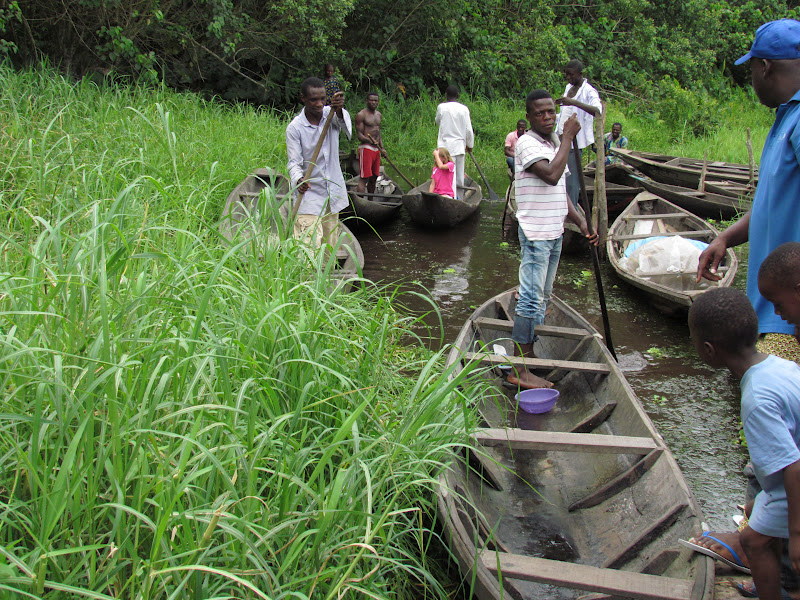
 We got to the water and our guide got us each into our own dugout canoe. The canoes were different sizes and he tried to match the canoe size with the passenger size. There were a couple that we rejected because they seemed to be about to sink.


 We passed quite a few boats that weren't going to be going anywhere soon -- or ever.


We stopped in a room behind the shop and the children sang us a couple of songs. One was about the "oyibo" (white person) and what it basically was saying was that they hoped the white people would bring them something of value. So it seems they are teaching the kids young to look for the white people to give them stuff. Not the lesson I would be teaching them....


I liked the Palm Sunday cross this child wore.


Some of the boatmen were really built, like this one. I was commenting on his muscles to the woman who rode in his boat and she said she was looking forward all the time and didn't even notice -- at least that's what she told her husband!


After paddling down the narrow canal, we came to a wider river.


We passed some other local boys having fun on the water.


Lining up for a picture.

And our boatmen treated us to a song, though I don't think the little girl in the canoe of the boatman dancing along with the song really appreciated it. She seemed kind of nervous.
We did some canoeing down some narrow canals that were really pretty and we seemed like we were in the jungle and away from civilization. At least, it seemed remote until the boatman in the canoe in front of me got a cell phone call and paddled with one hand while he talked on the phone.

And there were other evidences of civilization. The boatmen were not above product placement, though I don't know that he had a sponsorship deal.

We took a break from the water to visit the village of Iba-Oloja. We had to walk carefully on this raised plank platform from the dock to the land. Our guide said during the rainy season, the water would get up quite high, almost to the plankss.

We had lots of children greeting us here too.


Most of the village seemed quite primitive, but they did have a solar power system, with a sign crediting a Lagos State rural development initiative, with a reminder to pay their taxes.

I was told that this contraption is designed to heat water.

We were led to the village store, owned by our guide's father, and encouraged to purchase something to support local business. We bought a few packets of cookies and crackers and were surprised at how cheap they were -- much cheaper than at the stores where we shop.

We stopped in a room behind the shop and the children sang us a couple of songs. One was about the "oyibo" (white person) and what it basically was saying was that they hoped the white people would bring them something of value. So it seems they are teaching the kids young to look for the white people to give them stuff. Not the lesson I would be teaching them....
We walked through the agricultural area of the village and there were cassava fields and areas with large termite mounds and these piles of sticks. They had a water or soda bottle strung up on a pole above each pile. Our guide said it was voodoo -- they would put these bottles on the pile and no one would dare to steal the sticks because then they would be cursed from the voodoo. I guess whatever works....

Next we visited the village school.

And some kids were there playing soccer and other kids followed us -- there were LOTS of kids in this village! We only saw a handful of adults,

but we saw older kids were taking care of little kids.


We didn't see evidence of books or other supplies, but there was a locked door with a sign designating the "library." But there was this "passage reading" on a blackboard that I thought was interesting.

There's a big lack of books and other learning materials in Nigerian schools, so the children tend to learn a lot by rote and by reading from the blackboard.

We got back into our canoes and headed back to our starting point.


I wasn't able to get pictures of the pretty water birds we saw, but we didn't see any monkeys. There were some pretty water lilies.

Back in the village, we were greeted by more kids.

This boy was having fun playing with a live beetle tied on a string.

These kids were hard at work making some tomato puree.

Our guide took a few minutes to give us a demonstration on raffia making, which seems to be a village activity, based on the piles of raffia around. He said this one stalk would generate about 150 pieces of raffia.


It's always a good thing to get out of Lagos and get a different view of life in Nigeria.


