I feel very far away from Lagos, as my time comes to an end in Boston helping my daughter and her family move into their first home of their own. We've been very busy with removing wallpaper and painting and moving their belongings -- their former rented home is only a few minutes away -- and now the critical stuff is finished. They will still be getting organized and settling in for a while and have many home projects awaiting, but they are ready to be on their own, I'm sure. I've enjoyed spending time with them and their wonderful, energetic young sons. My daughter is expecting her third child in January and they just had an ultrasound yesterday that indicated they will be having their first daughter. We're all excited about that-- though my son-in-law will have to change up his visions of having a golf foursome with his sons -- my daughter reminds him that girls can play golf too.
In the United States, though we know life gives no guarantees, we tend to have the expectation that things will go well with pregnancy and childbirth. In Nigeria, childbirth is often more of a risk to both mother and child. I was reminded of that last week when I heard some very sad news from Lagos. I got to know the beautiful bride Ugoma through our church congregation over a year ago after she married Chinedu, who was a stalwart church member. Chinedu had been taking his time finding a wife, and he got a lot of kidding about how no woman seemed to be good enough for him. But we were all so happy for him after we met the woman he chose to marry -- Ugoma was sweet and beautiful and always had a radiant smile as we greeted each other with a hug at church. I'm so sorry that I don't seem to have snapped a picture of her. We were excited for both of them when we learned she was expecting their first child. I missed seeing her each week after our church congregations split off and we were meeting in another building. Last week I learned that she had fallen ill with malaria in June and was hospitalized for that until she gave birth, which had to be with a C-section as she was so weak. Ugoma and Chinedu had a healthy baby boy, and they named him Joshua. But Ugoma never recovered -- Chinedu said her incision wasn't healing and she had some abdominal swelling, so I don't know if she had internal bleeding or an infection, but she passed away a month after having the baby. I'm so sorry that I knew nothing of this while it was happening, as I was away through most of the ordeal. I wish I had known so I could at least have been praying for her. Chinedu says he will try to raise Joshua with a help of a nanny, which is quite an unusual thing for a Nigerian father to do. I feel so heartbroken for Chinedu, who finally found a wonderful wife and had her for such a short time, and for Joshua, who will grow up without the benefit of his mother's care. I wish there is something we could have done to get Ugoma some better health care.
This heartbreaking loss has been on my mind for the past week, as I have spent time with my pregnant daughter and healthy grandsons and I feel so blessed by the knowledge that they will have access to good health care and if illness and emergencies arise, there are skilled doctors and sterile hospitals awaiting to help them. But I've grown to love the Nigerian people during my time there and I shed tears for them, knowing that they deserve this benefit as well, but they don't have it. At irrational moments when I rage about the unfairness of it all, I wish for the Gates Foundation or some other aid agency with lots of money to throw at the problem to come in and make it all better. But I know that no outside charity can solve Nigeria's problems for them. Nigeria has a huge disadvantaged population, but they also have enormous resources that have gone too often to benefit too few. This corrupt culture of selfishness starts at the top with leaders who stash huge amounts of money in overseas bank accounts and it goes down to the scam artists who envision schemes to bilk others out of their money as their way to get ahead. Nigeria needs leaders at every level of society who will consider the greater good of their country as a priority and it needs citizens who value individual life, seize honest opportunities, and demand better from their leaders. Joshua will grow up never knowing his mother's care, and he deserves better from his country. A hope for a better life and a peaceful future is my prayer for him, for his father, and for Nigeria.
Wednesday, August 04, 2010


Tuesday, July 13, 2010
The 233rd good thing about Lagos: A new church building with easy access!
Our church congregation was divided recently, in the desire to allow worship closer to members' homes to save them the time and expense of travel. It's taken a while to actually make this happen (nothing happens quickly or easily in Nigeria), but finally in June our new meeting place was ready for use. This was fortuitious, as the road to our former church building can be treacherous during rainy season. The new building is a quick 5 minute drive from our house on roads that are paved and with minimal puddles. This is a great benefit that both we and our driver appreciate.
Many of the church members are now able to walk from their homes to church, and I know they are very grateful to be spared a lengthy ride on an okada to church. Our congregation is small, but we are always so glad to be together and I've enjoyed the opportunity to get to know the Nigerians much better than I did in a larger congregation. The past few weeks I've been the only expat woman there -- most of the other American women and children are away for the summer. The Nigerian members always make me feel very loved and valued and I'm going to miss them all for the next two months while I'm away. Our building was formerly an eye clinic and is just off a main road on the island of Ikoyi. Here's our main meeting room:
 We were away the first week they met in the building, but I got this photo of the members (with some missionary visitors) the second week in the building.
 There's always a good time mingling after services.

This is a photo of the Ekong family. They are such wonderful people and a real strength to our congregation.

I had to get a photo of the beautiful women in this family. Priscilla, on the left, is a former AWC scholarship student, and her youngest sister, Victoria, on the right, is a new scholarship recipient. She was home for a short time and left later this day to go back to her college town. Their father is a retired policeman and their mother worked for the government (and is still waiting for the government to give her the pension she was promised and she's been retired for several years). I've so enjoyed getting to know and love them.

Many of the church members are now able to walk from their homes to church, and I know they are very grateful to be spared a lengthy ride on an okada to church. Our congregation is small, but we are always so glad to be together and I've enjoyed the opportunity to get to know the Nigerians much better than I did in a larger congregation. The past few weeks I've been the only expat woman there -- most of the other American women and children are away for the summer. The Nigerian members always make me feel very loved and valued and I'm going to miss them all for the next two months while I'm away. Our building was formerly an eye clinic and is just off a main road on the island of Ikoyi. Here's our main meeting room:
 We were away the first week they met in the building, but I got this photo of the members (with some missionary visitors) the second week in the building.
 There's always a good time mingling after services.
This is a photo of the Ekong family. They are such wonderful people and a real strength to our congregation.

I had to get a photo of the beautiful women in this family. Priscilla, on the left, is a former AWC scholarship student, and her youngest sister, Victoria, on the right, is a new scholarship recipient. She was home for a short time and left later this day to go back to her college town. Their father is a retired policeman and their mother worked for the government (and is still waiting for the government to give her the pension she was promised and she's been retired for several years). I've so enjoyed getting to know and love them.

The 232nd good thing about Lagos: Giving a life-line to street boys
I had been hoping for a long time to be able to visit Child Life-Line, a charity that rescues boys from the streets and provides them a home and education so they can get a better start in life. We had been warned that the road leading to the charity can be impassable at times, so we were glad the rain held off till we were on the paved road home. There were still plenty of really muddy places, and other places where the road was like riding a roller coaster and the driver had to weave from one side to the other to avoid the deep puddles. I was glad we were in Ayoka's car that is higher off the ground and has 4-wheel drive!


After a bit of searching and several phone calls and questioning local residents, which led to boys from the center coming out to the main street to look for us, we found the unmarked gate which led to a narrower muddy road.

And the muddy road changed to a grassy path....

until we finally came to the gate with the sign marking the charity. They said the trip would probably take around an hour. It took us three.

But we were glad to make it and see this well-kept area which provides stability to boys ages 8-18 who have been gathered from life on the street. They currently have 19 boys, but have capacity for 24. They have an outreach program which helps to find boys who need rescue and some boys hear about the center and arrive there hoping to be helped. The young adult men working at Child Life Line, who showed us around, said some boys end up on the street after running away from home, some were discarded by their families, often after a remarriage. Most of the boys were at school during our visit, but there were some boys at home. They had recently arrived at the center and it was too late in the school year to get them registered. They were quiet and hesitant to talk to us, but they finally opened up and answered our questions. After their leader mentioned that one of the boys was a good artist, he showed us his sketch book and some very nice drawings.
We left Child Life Line feeling that those 19 boys living there were in a good place. We hope to be able to support the center and get them some things that will make it even better.


After a bit of searching and several phone calls and questioning local residents, which led to boys from the center coming out to the main street to look for us, we found the unmarked gate which led to a narrower muddy road.

And the muddy road changed to a grassy path....

until we finally came to the gate with the sign marking the charity. They said the trip would probably take around an hour. It took us three.

But we were glad to make it and see this well-kept area which provides stability to boys ages 8-18 who have been gathered from life on the street. They currently have 19 boys, but have capacity for 24. They have an outreach program which helps to find boys who need rescue and some boys hear about the center and arrive there hoping to be helped.
 The young adult men working at Child Life Line, who showed us around, said some boys end up on the street after running away from home, some were discarded by their families, often after a remarriage. Most of the boys were at school during our visit, but there were some boys at home. They had recently arrived at the center and it was too late in the school year to get them registered. They were quiet and hesitant to talk to us, but they finally opened up and answered our questions. After their leader mentioned that one of the boys was a good artist, he showed us his sketch book and some very nice drawings.
We sat with the boys in the dining hall while we visited with them. They get their own breakfast and there is a cook who prepares 2 meals a day for the boys. The directors said that they seem to consider this cook a mother figure and the boys are anxious to help her. She has challenges preparing food -- the charity's refrigerator and freezer are both currently broken. The kitchen was pretty bare and she said some donations of pots and dishes would be very helpful.

One building serves as a tailoring workshop to allow boys to learn the skill of sewing. They would appreciate donations of fabric to practice with.
 They have some space which allows for the boys to have room to run. They are responsible for doing their own washing of clothes and also have chores around the center to help them learn responsibility.
 This building is the dormitory.
 The rooms were clean, but very spare in furnishing. Some bunks had mosquito nets, but they didn't have enough for all the beds. Some beds had bare foam mattresses with no sheets. We hope to get donations of sheets so all the boys can have them.


This building serves as a classroom for their art teacher, an artist who, I believe they said, was once a resident of Child Life-Line. The leader showed us some pictures of the art work the students had created and there were some beautiful paintings. We're hoping to organize an exhibition and sell some of their works. The proceeds would go to each individual boy, not to the charity as a whole, so they can receive some benefit from their creations.

There is also a very comfortable administration building that has a library, study room and computer work area. They said that after school the boys spend a lot of time in here doing their homework and reading. I asked the leaders how the boys got along -- were there fights? And they both smiled and responded, "Well, they are boys." They often come to the center pretty tough after their lives on the street, and certainly there are challenges as they learn to be responsible and to get along with others. But they try to make it as much like a home as possible and the boys generally respond so the stability and structure.


One building serves as a tailoring workshop to allow boys to learn the skill of sewing. They would appreciate donations of fabric to practice with.
 They have some space which allows for the boys to have room to run. They are responsible for doing their own washing of clothes and also have chores around the center to help them learn responsibility. This building is the dormitory.
 The rooms were clean, but very spare in furnishing. Some bunks had mosquito nets, but they didn't have enough for all the beds. Some beds had bare foam mattresses with no sheets. We hope to get donations of sheets so all the boys can have them.


This building serves as a classroom for their art teacher, an artist who, I believe they said, was once a resident of Child Life-Line. The leader showed us some pictures of the art work the students had created and there were some beautiful paintings. We're hoping to organize an exhibition and sell some of their works. The proceeds would go to each individual boy, not to the charity as a whole, so they can receive some benefit from their creations.

There is also a very comfortable administration building that has a library, study room and computer work area. They said that after school the boys spend a lot of time in here doing their homework and reading. I asked the leaders how the boys got along -- were there fights? And they both smiled and responded, "Well, they are boys." They often come to the center pretty tough after their lives on the street, and certainly there are challenges as they learn to be responsible and to get along with others. But they try to make it as much like a home as possible and the boys generally respond so the stability and structure.


We left Child Life Line feeling that those 19 boys living there were in a good place. We hope to be able to support the center and get them some things that will make it even better.
The 231st good thing about Lagos: getting braille books to the blind in Nigeria
The Nigerwives Braille Book Production Centre is a charity that was created by the Nigerwives women's organization, a group that is made up of women from many nationalities who married Nigerian men and so are often permanent residents of Nigeria. They saw the need for books for the blind in Nigeria and found the means and know-how to make it happen. They operate out of 4 container buildings in some extra land that a university lets them use. They primarily print textbooks for school children.


They hire a number of visually impaired workers, who are well trained in their jobs. The man in the foreground of this photo proofreads all the books before they send them out. I bet he has tired and sore fingers at the end of the day.

They showed us the machines they use to emboss the pages with braille.

They have a computer training room where they have classes teaching visually impaired the adaptive technology that allows them to use the computer. The man on the right showed us how the computer voices all the commands so the user knows what is happening on the screen. He was well versed in Skype -- when we came up to him he had several Skype conversations going. He said Skype had changed his life. ;o)

One container building is stacked with donated boxes and paper. They are always needing donations of the thick paper they need to emboss for their braille books -- like calendars or company catalogs or promotional materials. They do get some books donated by an agency in the States. They are somewhat amused by the Braille books from the States that are printed on clean, new paper. They said the blind aren't aware that pages with braille have other printing on them, so there is no problem with recycling paper previously used for other things. The machine in this picture cuts the paper to the size they need for the books. They collect boxes for sending out the books. They also appreciate donations of other kinds of paper, which they sell to get funds for other things they need. I always save my boxes and magazines to bring to them.

There's a group of expat spouses (can't say "women" because there was a male trailing spouse who was a regular worker) who regularly meet here and cut paper for the braille books.
I'm hoping this year that I can fit it into my schedule.

Although I was really itching to get in there and organize their space, I really do appreciate the important work they are doing here -- getting training and education to the visually impaired in Nigeria. I also like how they are providing jobs for the visually impaired. That's a really good thing.


They hire a number of visually impaired workers, who are well trained in their jobs. The man in the foreground of this photo proofreads all the books before they send them out. I bet he has tired and sore fingers at the end of the day.

They showed us the machines they use to emboss the pages with braille.

They have a computer training room where they have classes teaching visually impaired the adaptive technology that allows them to use the computer. The man on the right showed us how the computer voices all the commands so the user knows what is happening on the screen. He was well versed in Skype -- when we came up to him he had several Skype conversations going. He said Skype had changed his life. ;o)

One container building is stacked with donated boxes and paper. They are always needing donations of the thick paper they need to emboss for their braille books -- like calendars or company catalogs or promotional materials. They do get some books donated by an agency in the States. They are somewhat amused by the Braille books from the States that are printed on clean, new paper. They said the blind aren't aware that pages with braille have other printing on them, so there is no problem with recycling paper previously used for other things. The machine in this picture cuts the paper to the size they need for the books. They collect boxes for sending out the books. They also appreciate donations of other kinds of paper, which they sell to get funds for other things they need. I always save my boxes and magazines to bring to them.

There's a group of expat spouses (can't say "women" because there was a male trailing spouse who was a regular worker) who regularly meet here and cut paper for the braille books.
I'm hoping this year that I can fit it into my schedule.

Although I was really itching to get in there and organize their space, I really do appreciate the important work they are doing here -- getting training and education to the visually impaired in Nigeria. I also like how they are providing jobs for the visually impaired. That's a really good thing.
The 230th good thing about Lagos: Visiting Family Care Center Ikota Clinic
This year I am handing over primary responsibility for the American Women's Club charities to a new Community Services chair and I will be her assistant this coming year as she transitions into the job. Thanks, Ayoka! We have a short overlap when we're in Lagos at the same time this summer and we took the opportunity to visit a few charities last week.
I've always enjoyed visiting the Family Care Center, Ikota Clinic, as it's a very well run charity where they provide needed services to their community. A visit to the clinic is on a sliding scale, but costs most patients just 500 naira, just over $3. The clinic is clean and is in a well kept building. The road in front of the clinic was just redone, so it was easy to get to, even during rainy season. This photo is of Andrew, the young American manager of the clinic, and the doctor that was on duty.


The children here are so beautiful!
 When the road was recently repaved, the clinic was able to get some trees donated from a local hotel who was going to lose them to a road widening project. They built a ramp and some nice planters for the trees in front of the clinic. It looks great!

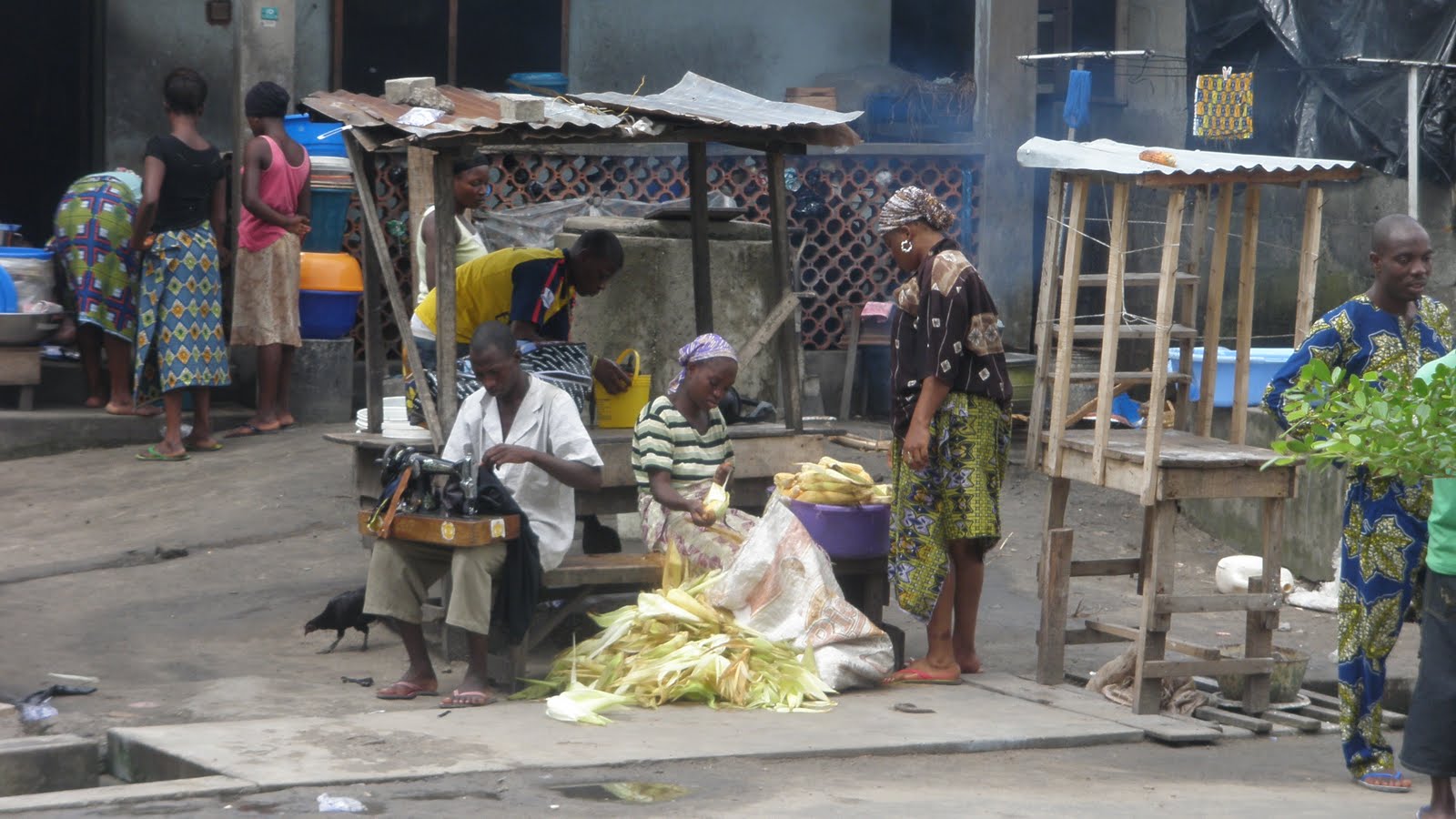
Standing in the street, looking at Family Care, you could be anywhere. But turning your head and looking at the other side of the street, it's clear that you're in Africa.

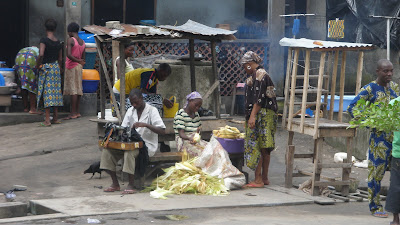
People are busy shucking corn, washing dishes, going about their daily work while chickens strut around between them. Nigerians are such hard workers!
I've always enjoyed visiting the Family Care Center, Ikota Clinic, as it's a very well run charity where they provide needed services to their community. A visit to the clinic is on a sliding scale, but costs most patients just 500 naira, just over $3. The clinic is clean and is in a well kept building. The road in front of the clinic was just redone, so it was easy to get to, even during rainy season. This photo is of Andrew, the young American manager of the clinic, and the doctor that was on duty.
 We were greeted by a smiling face at the reception desk. The clinic does dental work as well as medical and delivers a lot of babies. They have an antenatal clinic and class one morning a week where expectant mothers come to get checked and get some training about pregnancy and childbirth.
We walked around behind the clinic, where Andrew showed us how they are hoping to get funds to expand their building so they can have a ward with beds for patients. They are currently stretched for space. They have the plans, but don't as yet have the money to do this.
Behind the clinic is a school and I'm afraid we disrupted their lessons, as the children were curious to come look at the oyibos.


The children here are so beautiful!
 When the road was recently repaved, the clinic was able to get some trees donated from a local hotel who was going to lose them to a road widening project. They built a ramp and some nice planters for the trees in front of the clinic. It looks great!
Standing in the street, looking at Family Care, you could be anywhere. But turning your head and looking at the other side of the street, it's clear that you're in Africa.

People are busy shucking corn, washing dishes, going about their daily work while chickens strut around between them. Nigerians are such hard workers!
Saturday, July 10, 2010
The 229th good thing about Lagos: quiet time in the summer rainy season
I haven't spent much time here in Lagos in the summer in the past few years. This year I've had four weeks here (divided by a wonderful 2-week trip to Israel) and it will soon come to an end as I return to the States for a couple of months to help children and play with grandchildren. But I've enjoyed being here when things are less busy and I've had more time for projects and leisure. Before I moved to Lagos I was worried about being bored here -- now I worry about finding time for all the things I would like to do. I've had time this summer to work on piecing a quilt top. There's a fun quilting group with some experienced quilters who are helping newbies like me.
I don't know why sometimes I am unable to take a clear photo with my point and shoot camera, but here's a blurry picture of Teresa marking her quilt top for quilting. Notice her cute dress that matches her quilt, using some of the same fabric.
 Patty (with friends), holding up her quilt top. I really love the African fabrics here. My quilt top is in progress and it's not turning out quite like I had envisioned. It won't win any prizes and definitely will not be restful on the eyes, but I'm reserving judgement on it as yet. Pictures will be forthcoming.

There is also a beading group that I hope to get involved in when I return. The market is full of interesting beads and finding ways to use them for jewelry and home decoration is another creative outlet that many expat women enjoy here.
I've had some opportunity for tennis playing -- between rain storms -- and went to a book launch the other day. There's also still a small group of women to continue with our Thursday card playing, but many of my regular activities are on haitus while the majority of expats are away for the summer.
Summer is rainy season in Lagos, so many days we have some pretty hard rain. We had a big storm on Wednesday -- the floor inside the car got wet as Brent floated through flooded streets on his way to work. But Thursday was dry and Friday morning looked clear, so I decided to try to get to Lekki market to get some gifts to bring back to the States. The streets around the market are often flooded after a rain, and the carpeting inside the car got wet again as we made our way through these puddles.
 The challenge is always knowing how deep the puddles are. Usually my driver waits to see another car make their way through to see how deep it is and which side of the puddle they choose to go through.
 We saw some children coming out of a school along this street and many of the kids had on wader boots, most of them adult sized, so they came up to their thigh. I wish I had been fast enough to get a picture of them!

I don't know why sometimes I am unable to take a clear photo with my point and shoot camera, but here's a blurry picture of Teresa marking her quilt top for quilting. Notice her cute dress that matches her quilt, using some of the same fabric.
 Patty (with friends), holding up her quilt top. I really love the African fabrics here. My quilt top is in progress and it's not turning out quite like I had envisioned. It won't win any prizes and definitely will not be restful on the eyes, but I'm reserving judgement on it as yet. Pictures will be forthcoming.
There is also a beading group that I hope to get involved in when I return. The market is full of interesting beads and finding ways to use them for jewelry and home decoration is another creative outlet that many expat women enjoy here.
I've had some opportunity for tennis playing -- between rain storms -- and went to a book launch the other day. There's also still a small group of women to continue with our Thursday card playing, but many of my regular activities are on haitus while the majority of expats are away for the summer.
Summer is rainy season in Lagos, so many days we have some pretty hard rain. We had a big storm on Wednesday -- the floor inside the car got wet as Brent floated through flooded streets on his way to work. But Thursday was dry and Friday morning looked clear, so I decided to try to get to Lekki market to get some gifts to bring back to the States. The streets around the market are often flooded after a rain, and the carpeting inside the car got wet again as we made our way through these puddles.
 The challenge is always knowing how deep the puddles are. Usually my driver waits to see another car make their way through to see how deep it is and which side of the puddle they choose to go through.
 We saw some children coming out of a school along this street and many of the kids had on wader boots, most of them adult sized, so they came up to their thigh. I wish I had been fast enough to get a picture of them!
Sunday, July 04, 2010
The 228th good thing about Lagos: An American picnic on the 4th of July
I'm not spending a lot of time in Lagos this summer, but I did happen to be here on the 4th of July this year for the first time. I really enjoy this holiday in the States -- I love fireworks -- and I'm very much a patriotic person who often tears up at the national anthem. Although there's no fireworks here in Lagos this year, there was an all-American picnic at the Consul General's residence where there was lots of red, white and blue in evidence.
 There was American picnic food: burgers, hot dogs, ribs, potato salad, cole slaw and decorated cupcakes. The tents were assembled, as it's rainy season here and we can't hardly get through a day without a downpour. But the rain came in the morning before picnic time and the cloud cover kept the heat from being too oppressive. There were games for the kids and the adults. They managed to find someone willing to be dunked in the dunk booth even though the water was kind of brownish...

There was American picnic food: burgers, hot dogs, ribs, potato salad, cole slaw and decorated cupcakes. The tents were assembled, as it's rainy season here and we can't hardly get through a day without a downpour. But the rain came in the morning before picnic time and the cloud cover kept the heat from being too oppressive. There were games for the kids and the adults. They managed to find someone willing to be dunked in the dunk booth even though the water was kind of brownish... The adults threw darts at balloons for prizes, including some "Obama" perfume -- probably not an officially licensed Obama product.
 Our wonderful Consul General who will be leaving Lagos soon took a turn manning a game at the children's area.

And she led us in the Pledge of Allegiance and the National Anthem, accompanied by the flute

Our wonderful Consul General who will be leaving Lagos soon took a turn manning a game at the children's area.
And she led us in the Pledge of Allegiance and the National Anthem, accompanied by the flute

It may be the only Independence Day that I spend in Lagos, so I'm glad I was able to do something with other Americans to recognize the holiday. I hope my American blog readers are celebrating the 4th of July with a bang!
Subscribe to:
Posts (Atom)