Tuesday, January 30, 2007
The 25th good thing about Lagos: They are working at democracy -- but seeing their system makes you appreciate the US election machine.
Nigeria's government has huge problems. It's a country with great resources, but so much is lost to corruption. The money oil brings in isn't being used to help the populace in general or build a workable infrastructure. But they are making attempts. Friday and Monday were holidays within the country to allow the population to register to vote. Our driver said he wasn't going to register on Monday because the lines would be too long. He would do it another time. There was a huge crowd shopping in the grocery store and at the mall yesterday, so many others agreed with him. And he said that though the election is currently scheduled for April, they may need to postpone it till August because the voting machines may not be ready. This election should (and hopefully will) mark the first time a Nigerian government has changed peacefully. But campaigning has already been marked by bombings and assassinations of promising candidates by rivals. Americans may think their election process needs some revamping -- but take a look at Nigeria's -- and the US machine seems to be in pretty good shape. Here there are lots more problems than hanging chads.


Monday, January 29, 2007
The 24th good thing about Lagos: Arriving safely with all our luggage and secret parcels that won't ever make a spy movie.
It's Monday evening, and we arrived here on Saturday evening -- getting in to the apartment around 10:30 PM after what was, for me, a trip of just over 30 hours. I had to change planes and airlines in Chicago -- Brent got on the direct flight to London from Houston. We met up in the BA lounge in London. I've got to say -- flying Business class is great! I'm too cheap to pay the premium myself. But when the company is paying, I certainly enjoy it! The trip was very comfortable -- the only annoyance being on the Lagos to London flight when the inflight entertainment system wasn't working. Oh well, it was a trial, but we managed to endure it. I'll have to watch The Illusionist another time.

There was one slightly disappointing thing to me. When I applied for my STR visa in Houston, which is a resident-type visa, the company sent my passport off to the Nigerian Embassy in Washington, and it was returned with a thick manila envelope marked: "DO NOT OPEN THIS ENVELOPE! It is to be hand-carried in to Nigeria with you and opened when you arrive by a Nigerian customs official." I don't know if it is just documents, or if it also contains bribe money -- or what -- it is a mystery. And I worried about stumbling through a reply to the airline ticket agent when I was asked the security question asking if anyone I didn't know had given me something to take on my flight. But, thank goodness, they've done away with that security question with the looming threat of 2 oz. bottles of mouthwash and mini tubes of toothpaste. But I imagined some kind of hand-off to the customs guy -- I didn't know if it was going to be on the sly, or over the counter. I kind of was hoping for some intrigue with it -- and I wanted to catch a glimpse of what was inside. But, no, Brent told me -- I'm just supposed to give it to some company person and they bring it over to the consulate and take care of it. Oh well -- in Nigeria, probably most often boring is better.
It was comforting to me to arrive to the same familiar apartment that I stayed in last summer. Things in the city seem much the same -- although a construction project of a walkway along the beach seems to be finished and looks quite nice. I'm sure it will be featured in a future blog entry when we find the time/get up the nerve to go walking along the beach.
I've been getting things organized in the apartment. Because Brent's been sharing it with other guys, he's kept his belongings in the bedroom storage areas. But now, we have the apartment to ourselves, so the food went into the kitchen cupboards and things have spread out to other closets and dressers. There's plenty of storage space for what we have.
I did some grocery shopping today -- the driver came back from exchanging money for us with a thick wad of 200 naira notes -- the exchange rate is 129 naira to the dollar. Food and goods, especially things that have been imported are very expensive here. As close as I can tell most things are about 3-4 times what they would cost in the US. I've never spent $9 for a box of cereal before. I declined to buy a tub of Crisco for $25 -- I'll wait till I absolutely need it. But my grocery bill for my 8 bags of groceries came to $15,000 naira (about $116)-- and I had to pay for it with 200 naira notes -- oh my hands felt scummy after counting out that money. I reached for the hand sanitizer as soon as I got to the car!

There was one slightly disappointing thing to me. When I applied for my STR visa in Houston, which is a resident-type visa, the company sent my passport off to the Nigerian Embassy in Washington, and it was returned with a thick manila envelope marked: "DO NOT OPEN THIS ENVELOPE! It is to be hand-carried in to Nigeria with you and opened when you arrive by a Nigerian customs official." I don't know if it is just documents, or if it also contains bribe money -- or what -- it is a mystery. And I worried about stumbling through a reply to the airline ticket agent when I was asked the security question asking if anyone I didn't know had given me something to take on my flight. But, thank goodness, they've done away with that security question with the looming threat of 2 oz. bottles of mouthwash and mini tubes of toothpaste. But I imagined some kind of hand-off to the customs guy -- I didn't know if it was going to be on the sly, or over the counter. I kind of was hoping for some intrigue with it -- and I wanted to catch a glimpse of what was inside. But, no, Brent told me -- I'm just supposed to give it to some company person and they bring it over to the consulate and take care of it. Oh well -- in Nigeria, probably most often boring is better.
It was comforting to me to arrive to the same familiar apartment that I stayed in last summer. Things in the city seem much the same -- although a construction project of a walkway along the beach seems to be finished and looks quite nice. I'm sure it will be featured in a future blog entry when we find the time/get up the nerve to go walking along the beach.
I've been getting things organized in the apartment. Because Brent's been sharing it with other guys, he's kept his belongings in the bedroom storage areas. But now, we have the apartment to ourselves, so the food went into the kitchen cupboards and things have spread out to other closets and dressers. There's plenty of storage space for what we have.
I did some grocery shopping today -- the driver came back from exchanging money for us with a thick wad of 200 naira notes -- the exchange rate is 129 naira to the dollar. Food and goods, especially things that have been imported are very expensive here. As close as I can tell most things are about 3-4 times what they would cost in the US. I've never spent $9 for a box of cereal before. I declined to buy a tub of Crisco for $25 -- I'll wait till I absolutely need it. But my grocery bill for my 8 bags of groceries came to $15,000 naira (about $116)-- and I had to pay for it with 200 naira notes -- oh my hands felt scummy after counting out that money. I reached for the hand sanitizer as soon as I got to the car!
Monday, January 08, 2007
The 23rd good thing about Lagos: Looking forward to a big lifestyle change that hopefully will help me keep my New Year's resolutions.
It's been a long time since I've written. The project my husband is working on has gone through some real stormy seas and it looks to me like the company may pull out of it. Brent thinks that it will take some time for them to actually do this -- and there's still a chance that they'll hang on and the economics may turn in their favor. We decided that it's too tenuous to sell the house now, but we want to get going on the full expatriate benefits package, which won't start until I move over there. So -- we've found someone to watch the house for us and I plan on going over there at the end of January for a couple of months. Brent just went back, but he is planning on coming back for meetings in Houston at least by the last week in January, and if my visa is ready, I'll be able to go back with him. I'll be in Lagos until the beginning of April, when my daughter is due to have her first child in Boston. I'll be with her as long as is helpful, and then I'll come back to Houston. I'll spend the end of April and May here, rehearsing with the Symphony Chorus for our European tour, which begins the last week of May. Hopefully by this time, we'll know if we should sell the house and make a more permanent move. It will be a better time to sell a house, anyway. So hopefully the house will do survive our absence okay, and it won't be a nightmare getting it in shape to sell after a few months of neglect. Anyway, my son in his blog listed some of his New Year's Resolutions, so I decided to do the same here. I'm looking ahead to some big changes in Lagos and realize that one has to go into life there with different expectations and a positive mindset to survive and be happy in a place where much of life is very challenging. 1. I feel the need to be more prayerful. I would especially like to be more consistent with a prayer and meditation time each morning. I really think this is important living in a place where you face some very real risks just with going about your daily activities. And because Lagos is a place with such chaos, starting each day with an activity inviting peace into my mind and heart will be really essential. 2. I want to live with a spiritual mindset where I can ask God in prayer to lead me each day to places where I can serve and do some good. With moving to a new place, there's always a big freeing up of time until you get sucked into new activities. When I leave the busy-ness and many commitments of my life here, it will allow me to be free to put my life in God's hands and let His Spirit help me discover how I should spend my time. 3. I'll be living in an apartment that, although very adequate, doesn't have many of the things that make my life easier in my home. So I realize that I need to resolve to let go of THINGS, and be happy with less and make do without many of the comforts and possessions that here in Houston I consider pretty much essential. Of course, it's easier knowing that at first I will just be there for 2+ months and then I'll be back to all my "stuff." It's not hard to camp out for that long. But I'm hoping I'll realize that I can live happily with many fewer possessions, and that knowledge will make it easier to do the down-sizing that will still need to be done if we end up selling the house and moving for a longer period of time. 4. Of course, each year I have the requisite dieting and exercise resolutions. I think living in Lagos will make this one much easier. Food is VERY expensive there and there's not all the appetizing options that are so tempting here in the US, so, although eating healthily will be more challenging, I think it will be easier to eat less. And the past few years I've developed some really healthy exercise practices that I know I'll continue there, even though the apartment exercise room is a pale substitute for the 24 hour Fitness club that I frequent here. But with fewer regular commitments, I'm sure I'll make time each day for exercise. Okay -- that's enough for now!
Friday, October 20, 2006
The 22nd good thing about Lagos: Amazingly enough -- the happiest people live here!
One very interesting thing I learned during my time in Lagos is the results of a survey that the Nigerians like to publicize. The World Values Survey, publicized in 2003, found the Nigerians to be top on their list of 65 surveyed countries for the happiness of their people. "The survey is a worldwide investigation of socio-cultural and political change conducted about every four years by an international network of social scientists. It includes questions about how happy people are and how satisfied they are with their lives." That's from a BBC article about the results: here's the link to the article.
http://news.bbc.co.uk/1/hi/world/africa/3157570.stm
There's plenty of other stuff on the web about this survey as well. But when people hear about all the violence and kidnappings and killings, etc. etc. that goes on in Nigeria, it's difficult to reconcile that with the world's happiest people. And when a spoiled and pampered American such as myself sees how most Nigerians live -- the desperate poverty and unhygenic and difficult living conditions, it's hard to believe that they could be happy with their lives. Here's more from that BBC article:
"Nigeria has the highest percentage of happy people followed by Mexico, Venezuela, El Salvador and Puerto Rico, while Russia, Armenia and Romania have the fewest. But factors that make people happy may vary from one country to the next with personal success and self-expression being seen as the most important in the US, while in Japan, fulfilling the expectations of family and society is valued more highly. The survey appears to confirm the old adage that money cannot buy happiness. The researchers for World Values Survey described the desire for material goods as "a happiness suppressant". They say happiness levels have remained virtually the same in industrialised countries since World War II, although incomes have risen considerably."
Another article (http://www.transnational.org/forum/power/2004/01.01_NigeriaHappiness.html)
quotes Nigerians saying why they are happy:
"Peter puts it down to God and music. "We have a great religious faith. Whether we are Christians like us or Muslims as in the north, we all believe ardently that God is looking after us. We believe in being our brother's keeper". Ele is perhaps more perceptive, "people smile at you because that is the way they deal with the awful stress in their poverty stricken life. I can take you to people in the village who are hungry, who are not happy, and God is just in their lives to give them solace. One reason why many of us are happy is that we don't ask for much. If God gives us food we easily become happy. We are not greedy. Gloria said, "You see it in how we move. It's a movement inside us and in society. We feel full of music and love of God. Her friend, the business woman, added, "We Nigerians look after each other. If I know you and you are hungry or ill I will try and help". The engineer said: "It was in our old tribal traditions and religion built on that. Have you ever seen such a religious people?"
It's definitely something to think about. Oh yes, where did the US fall in the happiness survey? 16th place.
http://news.bbc.co.uk/1/hi/world/africa/3157570.stm
There's plenty of other stuff on the web about this survey as well. But when people hear about all the violence and kidnappings and killings, etc. etc. that goes on in Nigeria, it's difficult to reconcile that with the world's happiest people. And when a spoiled and pampered American such as myself sees how most Nigerians live -- the desperate poverty and unhygenic and difficult living conditions, it's hard to believe that they could be happy with their lives. Here's more from that BBC article:
"Nigeria has the highest percentage of happy people followed by Mexico, Venezuela, El Salvador and Puerto Rico, while Russia, Armenia and Romania have the fewest. But factors that make people happy may vary from one country to the next with personal success and self-expression being seen as the most important in the US, while in Japan, fulfilling the expectations of family and society is valued more highly. The survey appears to confirm the old adage that money cannot buy happiness. The researchers for World Values Survey described the desire for material goods as "a happiness suppressant". They say happiness levels have remained virtually the same in industrialised countries since World War II, although incomes have risen considerably."
Another article (http://www.transnational.org/forum/power/2004/01.01_NigeriaHappiness.html)
quotes Nigerians saying why they are happy:
"Peter puts it down to God and music. "We have a great religious faith. Whether we are Christians like us or Muslims as in the north, we all believe ardently that God is looking after us. We believe in being our brother's keeper". Ele is perhaps more perceptive, "people smile at you because that is the way they deal with the awful stress in their poverty stricken life. I can take you to people in the village who are hungry, who are not happy, and God is just in their lives to give them solace. One reason why many of us are happy is that we don't ask for much. If God gives us food we easily become happy. We are not greedy. Gloria said, "You see it in how we move. It's a movement inside us and in society. We feel full of music and love of God. Her friend, the business woman, added, "We Nigerians look after each other. If I know you and you are hungry or ill I will try and help". The engineer said: "It was in our old tribal traditions and religion built on that. Have you ever seen such a religious people?"
It's definitely something to think about. Oh yes, where did the US fall in the happiness survey? 16th place.
Monday, October 02, 2006
The 21st good thing about Lagos: Having a church congregation where I can worship, where I feel needed and welcome and where there's great singing!
 My second Sunday in Lagos we went to church in our local church congregation (our ward service, as differentiated from our larger stake conference the week before . The Victoria Island ward of the Church of Jesus Christ of Latter-Day Saints meets in a large rented house. It serves the purpose, though it's definitely not as nice as the church-built building on the mainland. Most of the congregations in the Stake have a permanent building, but we don't have the necessary numbers in our ward. It looks nicer on the outside than it does on the inside. (The American women warned me to avoid using the bathroom at all costs!) But the meetings were very nice and much like what I'm accustomed to in the States. We had the women's meeting (Relief Society) first.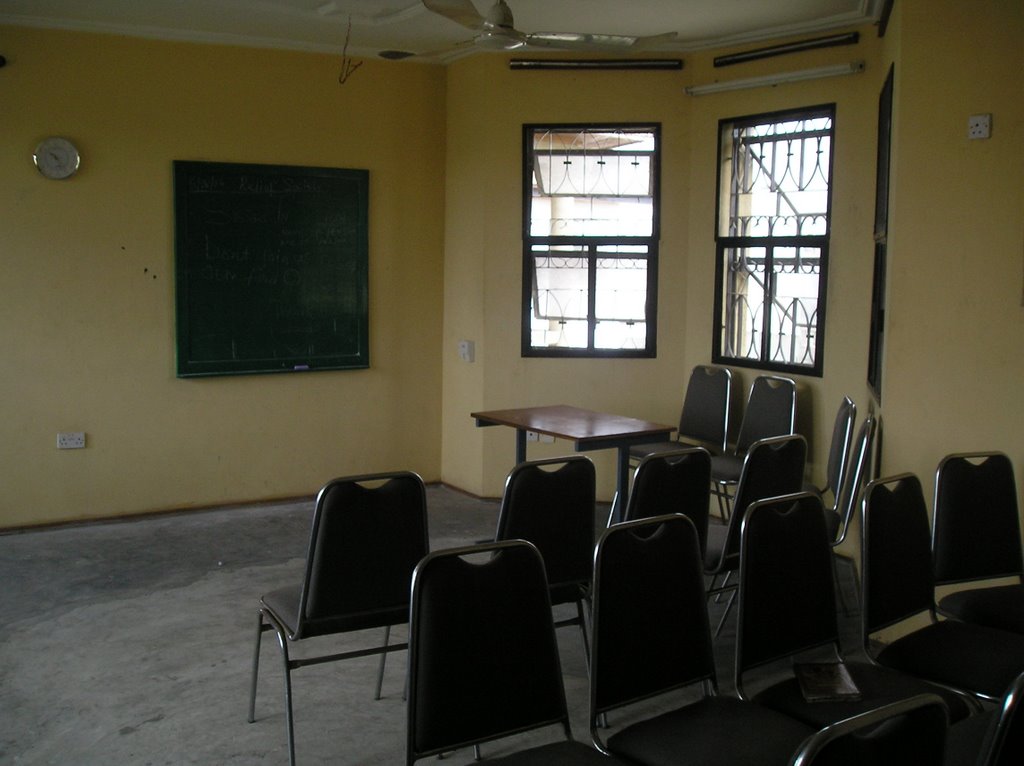
Here's a picture of the room, which is on the 2nd floor and pretty bare. But it was full of women with wonderfully colorful African clothes and big smiles and warm hearts. Though the room had bare cement floors and no other decoration -- they moved the table to the front and covered it with a bright blue tablecloth with the Relief Society motto stamped in gold on it -- "Charity never faileth." And on top was a blue vase with blue silk flowers. I was so moved by their efforts to beautify this spare room. Even in Nigeria, you can't get away from centerpieces in the RS classroom! The woman next to me shared her lesson manual and the teacher gave a great lesson and we had a nice discussion. I wanted to take a picture afterwards, but the women were gathered around me and introducing themselves and welcoming me. They were very sweet. I then went downstairs to the main chapel where we had Sunday School. The lesson was on Job, and it was very well-taught. As we were discussing the sufferings and trials of Job, I thought about what I guessed were the realities of the lives and trials of many of the members in that room. I know if many of us in our comfortable American lives were faced with what these Nigerians dealt with every day, we would consider ourselves as sorely tried as Job. We had been told that in the Stake, there is 60% unemployment among the members, but in our ward, there is 80% unemployment. And life is difficult for Nigerians even with jobs -- without work, I know that many of these people must live very desperate lives. But you wouldn't know it to look at them. I know it is a challenge for the expatriates who worship in Lagos, because they are sometimes approached and asked to help out families in situations of need. I'm sure they do provide help in many ways, but we are advised to remind them that the proper channel is to go to the bishop and ask for assistance and he will determine what is appropriate.
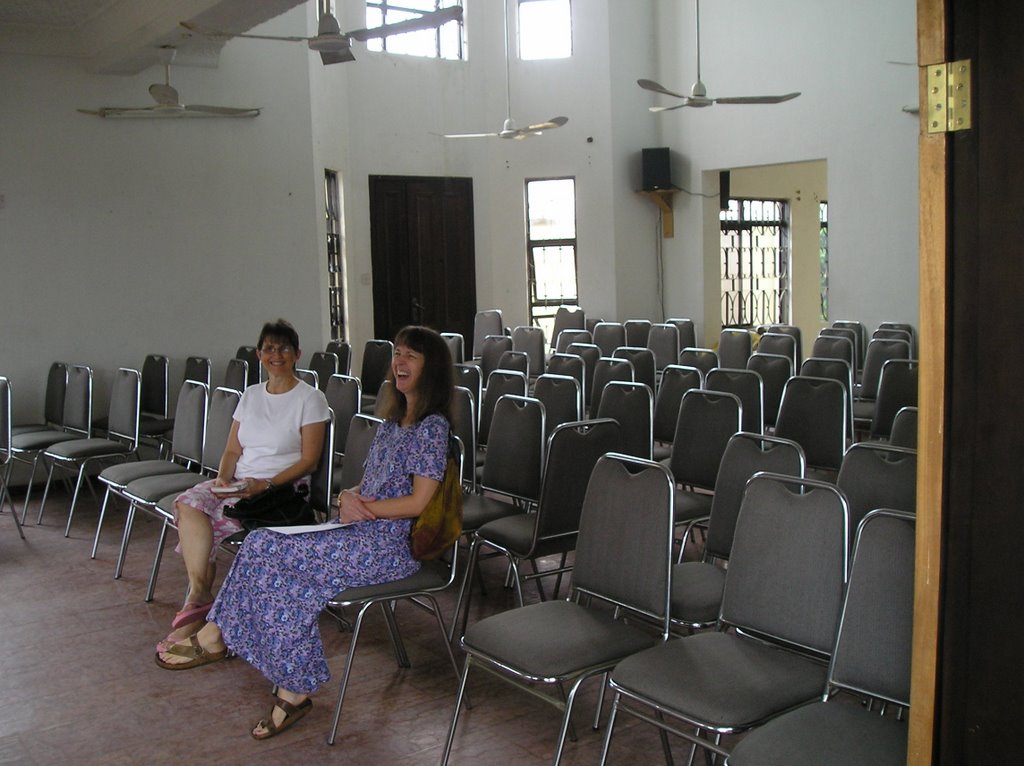 My new expatriate LDS friends brought me by the church building earlier in the week, and I got this picture of them in the chapel. On Sunday, the power was out and I guess the church either doesn't have a generator, or it was out as well, because the fans and microphone weren't working. It wasn't too bad sitting next to an open window with a breeze, but I imagine on a hotter day, it could be very difficult! The keyboard must have a backup battery, because it worked. They had heard that I played the piano, and asked me to play for the sacrament meeting service. They usually just have a missionary (a Nigerian) playing the keyboard, and Brent had told me that though he tried, he wasn't very experienced. The missionary very sweetly asked if he could sit by me while I played and watch how I moved my fingers so he could learn from me. I was glad to have his help with figuring out the techicalities of the keyboard, as well. I wish I could have had time to teach him a few lessons -- he was so eager to learn and was disappointed to hear that I was leaving that day. After I left, Brent said that he had been transferred and the ward now doesn't have anyone to play, so they sing without accompaniment. He said they ask every week when I will be back. I hope that when I'm there I'll be able to teach some piano lessons to some ward members so that eventually they'll have permanent people there to play for them. But the Nigerians LOVE to sing! (Even if their hymn books are almost falling apart, as you see in the picture here.)
 They sing out loud and strong and it's really exciting to be singing with them. We sang an intermediate hymn of "All Creatures of our God and King" and the ending was different than what they were used to -- the melody holds onto the note while the lower parts move and this confused some of them. So right after the meeting the bishop stood up and asked everyone to practice that hymn again because they had been singing it wrong and he wanted them to learn to do it right. I thought that was pretty neat. Also, during the meeting he sent me a note asking if I would bear my testimony in 2 minutes. This made me smile, because when we were over at our friend's house for dinner earlier in the week, they were discussing how in testimony meeting the bishop has a thing about not wanting people to speak for more than 2 minutes. He thinks if they talk longer they are taking someone else's time. He'll hold up a 2 minute warning sign, or nudge them to let them know they're going over their time limit. So I was careful to not talk too long. But the service itself was very good -- another missionary from Ghana was leaving to go home and he spoke his goodbye and told of his love for the people in the ward. There were probably a little over 100 people there in the meeting. Though the women were in brilliant African clothes, all the men in the room (except my husband, who wore a blue shirt that day) were dressed in Western dress with white shirts. One of the Americans had previously asked the bishop why the men never wear African dress to church and he had responded that they had been told that a white shirt is the appropriate dress for a priesthood holder and if they wanted to participate in the priesthood ordinances, they should wear a white shirt. I have mixed feelings about this. I know white shirts symbolize purity before God and I think it's a powerful symbol, though I do believe God cares much more about what's in our hearts than what we wear. But I was very touched by how all the men in the ward choose to obey their leader and honor their priesthood. I came away from worshipping with these Nigerian saints with the strong impression that though I certainly would be welcome and could contribute with things like my musical ability, I would also love the opportunity to learn from these humble and faithful people.
Friday, September 22, 2006
The 20th good thing about Lagos: Having a driver!
I've never before lived in a place where I had a driver and I must say, it's something I could get used to! In Lagos, it is absolutely essential -- I would never dare to negotiate the wild and crazy traffic scene and trying would be very stressful. It's quite relaxing to be driven around. I generally spent my car time looking around me wide-eyed at the foreign-ness of everything. But maybe eventually I would get to the point where I might do some reading or napping on the road. This is a photo of Dennis, who was our driver for most of my time in Lagos. During the week he generally wore a white shirt and slacks, except on Friday, which is Nigerian dress day at the office. I took this picture on our last day there, Sunday, and he was more casually dressed than usual. He generally drove for an employee who was then on vacation. I don't think he was thrilled with the reality of driving a "wife," because he had to work during the day and drive me here and there instead of having the day free to visit with his fellow drivers. But he did a fine job of plunging his car ahead into the roundabouts and taking the right-of-way even when others were attempting to do the same. We had some very close scrapes, but never actual contact with other vehicles. I felt like he really took pride in the car. ConocoPhillips has what I felt like was a 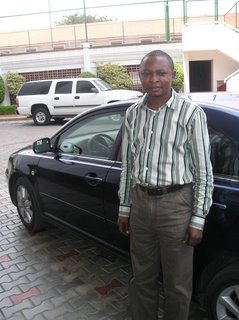 pretty workable plan for vehicles. They have a fleet of cars and hire the drivers. Each expatriate will have a driver that is assigned to them, but on their days off, they will provide you with someone else to drive you around. Each family will have the use of one car and driver at no cost to the expatriate. If we were to need a second vehicle (which I don't think we will), the company would deduct an "auto cost factor" from our paycheck. They basically figure an average cost for a vehicle and gas and take that from you. But it's a pretty nice perk, I think to have a car and driver and gas at no cost. They provide that because, frankly, at times it is an inconvenience to have to plan ahead to have the driver there when you need him and not always have the car instantly at your disposal. And when you need your driver at night, you realize that you're keeping him from going home to his family, so that kind of made me feel bad for him. Dennis looks like a really young guy, but actually he has a 19 year old son -- he said he became a father when he was just a teenager and his parents pretty much raised his son. He's now married with, I think, 3 young children. He came to Lagos many years ago and wanted to go to college to be an engineer, but he didn't have enough money, so he got a job as a driver. He still tries to take some classes in his spare time in hopes to get a better job. But he says that driving is a pretty good job. The drivers have security training and they are our protection, though driving around the islands, they are not generally armed. They all have cell phones, as well as a radio in the car and every 15 minutes or so, they call in their position to the radio room. The radio room monitors any areas of disturbance in the city and will let the drivers know of areas to avoid. Several years ago on Victoria Island (which is considered a safer part of Lagos) there was a carjacking of a ConocoPhillips car -- the expatriate was released unharmed, but the driver was killed. In a dinner discussion, an expatriate said that was often the case with crime here, the expatriate's money or possessions will be taken, but they will usually be unharmed. Nigerian lives don't get the same respect. That's maybe a bit reassuring for me -- but I certainly hope that I am never in a position where someone else becomes a victim in an attempt to protect me.
 pretty workable plan for vehicles. They have a fleet of cars and hire the drivers. Each expatriate will have a driver that is assigned to them, but on their days off, they will provide you with someone else to drive you around. Each family will have the use of one car and driver at no cost to the expatriate. If we were to need a second vehicle (which I don't think we will), the company would deduct an "auto cost factor" from our paycheck. They basically figure an average cost for a vehicle and gas and take that from you. But it's a pretty nice perk, I think to have a car and driver and gas at no cost. They provide that because, frankly, at times it is an inconvenience to have to plan ahead to have the driver there when you need him and not always have the car instantly at your disposal. And when you need your driver at night, you realize that you're keeping him from going home to his family, so that kind of made me feel bad for him. Dennis looks like a really young guy, but actually he has a 19 year old son -- he said he became a father when he was just a teenager and his parents pretty much raised his son. He's now married with, I think, 3 young children. He came to Lagos many years ago and wanted to go to college to be an engineer, but he didn't have enough money, so he got a job as a driver. He still tries to take some classes in his spare time in hopes to get a better job. But he says that driving is a pretty good job. The drivers have security training and they are our protection, though driving around the islands, they are not generally armed. They all have cell phones, as well as a radio in the car and every 15 minutes or so, they call in their position to the radio room. The radio room monitors any areas of disturbance in the city and will let the drivers know of areas to avoid. Several years ago on Victoria Island (which is considered a safer part of Lagos) there was a carjacking of a ConocoPhillips car -- the expatriate was released unharmed, but the driver was killed. In a dinner discussion, an expatriate said that was often the case with crime here, the expatriate's money or possessions will be taken, but they will usually be unharmed. Nigerian lives don't get the same respect. That's maybe a bit reassuring for me -- but I certainly hope that I am never in a position where someone else becomes a victim in an attempt to protect me.
Thursday, September 21, 2006
The 19th good thing about Lagos: Going through the jungle to see a shipwreck!
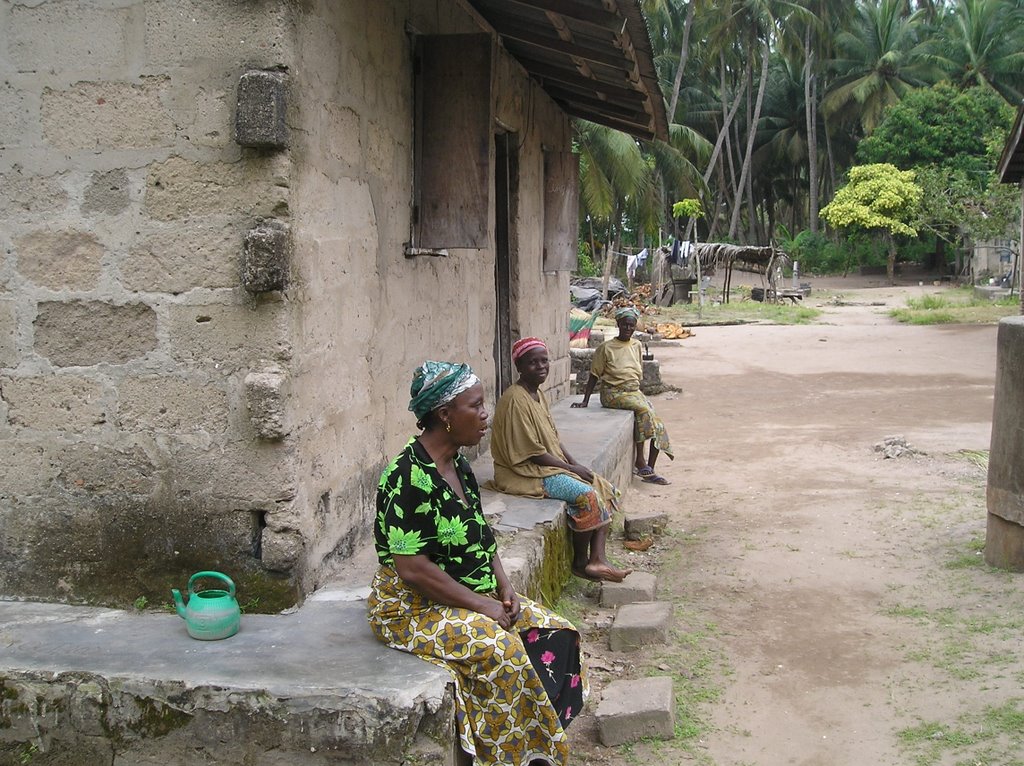
The more distance I have from my trip to Lagos, the harder it is to make time to write more blog entries -- though I haven't run out of ideas. But Brent just got back today from Lagos, and talking to him about what he's doing there has gotten me excited again about going back. It's easy to get into the busy-ness and ease of life here and wonder why I want to go through all the work to move over there -- and there is still so much to do to make it happen! But, I hope it will eventually. I think about the amazement I felt the day we went to the beach house and our hosts asked us if we would like to visit a shipwreck that was just up the peninsula a bit. Of course, I was all for it. We took a short boat ride and tied up the boat to a tree on the banks of a creek that was by a little village. Below are photos of the village where we went ashore. 
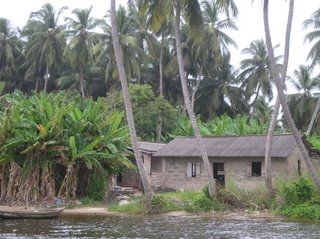
It was amazing the difference in the plant growth just this short distance away. By the beach hut there was just coconut palms and sand. Here, it was jungle. Our hosts said when they had been there before they saw monkeys in the trees, though we didn't when we were there. A snake did cross the path, and we saw lots of chickens running around the villages, but that was it as far as wildlife goes.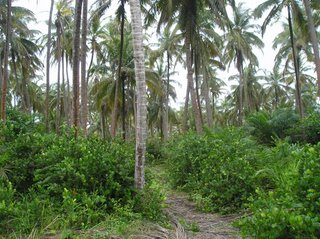 Here the peninsula was wider between the creek and the ocean beach and we hiked along a path passing several primitive villages with palm huts.
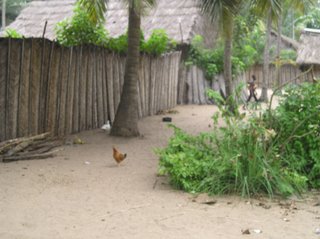
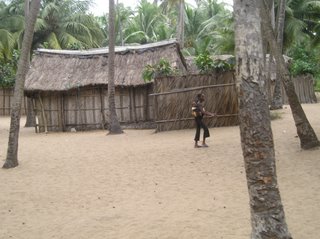 They all had piles of coconut shells beside the huts. I don't know if they were just garbage piles, or if they kept the shells for fuel.
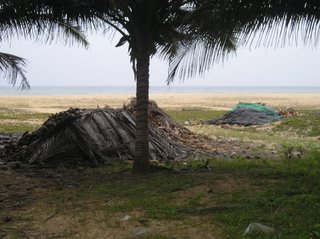
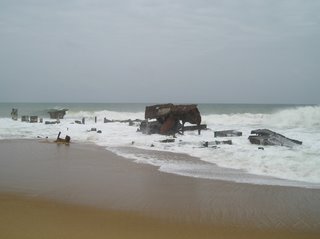
There wasn't much left of the ship. I think they said it had just ran aground in 1998, and the villagers thought the ship, with its load of furniture and goods, was a gift from the gods. They cleaned it out pretty quickly. But the hull and parts which were left there have really altered the beach and the sands of the whole peninsula as the tides were changed to go around the wreck. Now there has been a lot more sand deposited there and the village is much further from the water than it was before. I thought it was interesting how in just 7-8 years there could be such a big change in the whole land area of the peninsula.
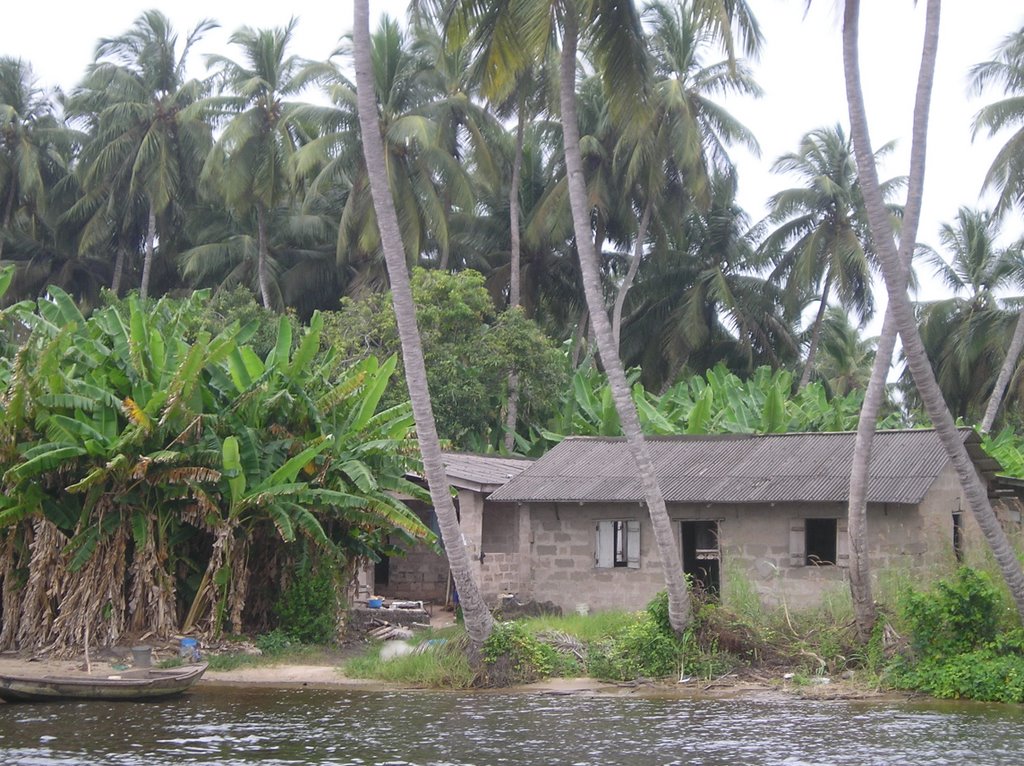
It was amazing the difference in the plant growth just this short distance away. By the beach hut there was just coconut palms and sand. Here, it was jungle. Our hosts said when they had been there before they saw monkeys in the trees, though we didn't when we were there. A snake did cross the path, and we saw lots of chickens running around the villages, but that was it as far as wildlife goes.
 Here the peninsula was wider between the creek and the ocean beach and we hiked along a path passing several primitive villages with palm huts.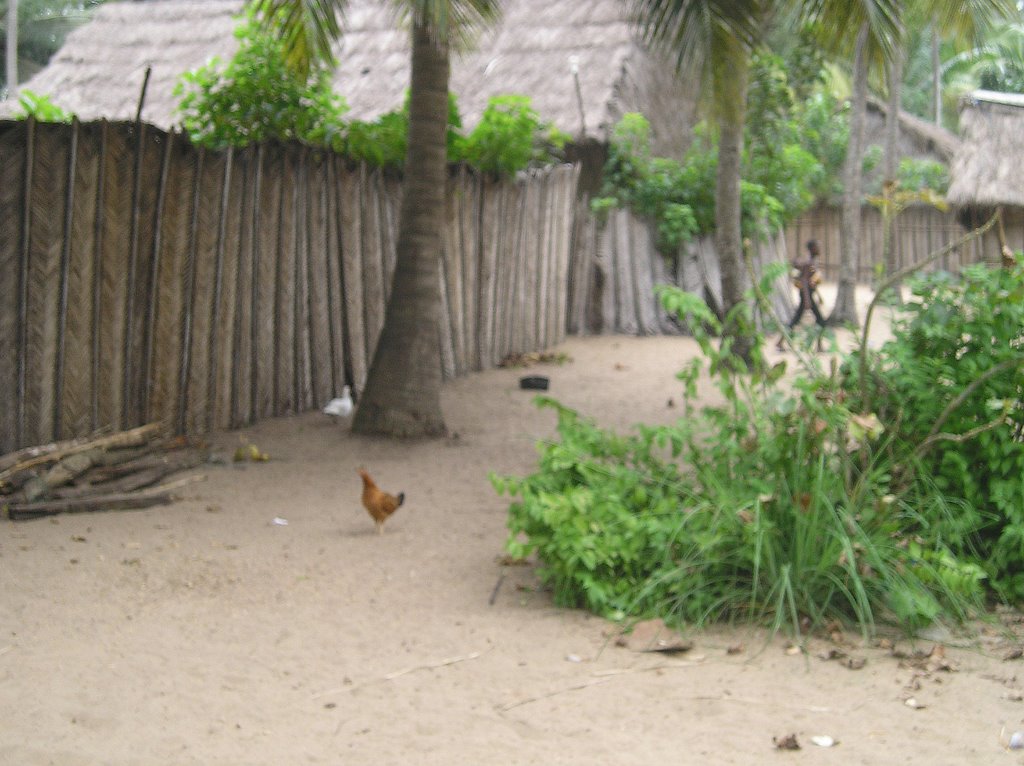
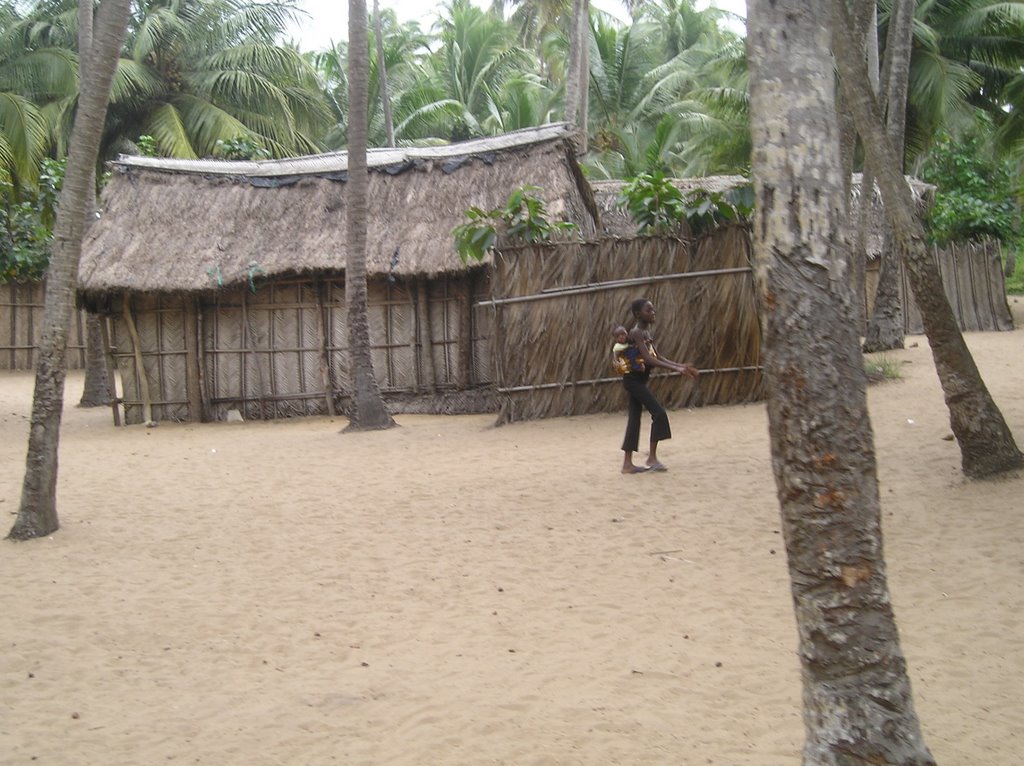 They all had piles of coconut shells beside the huts. I don't know if they were just garbage piles, or if they kept the shells for fuel.
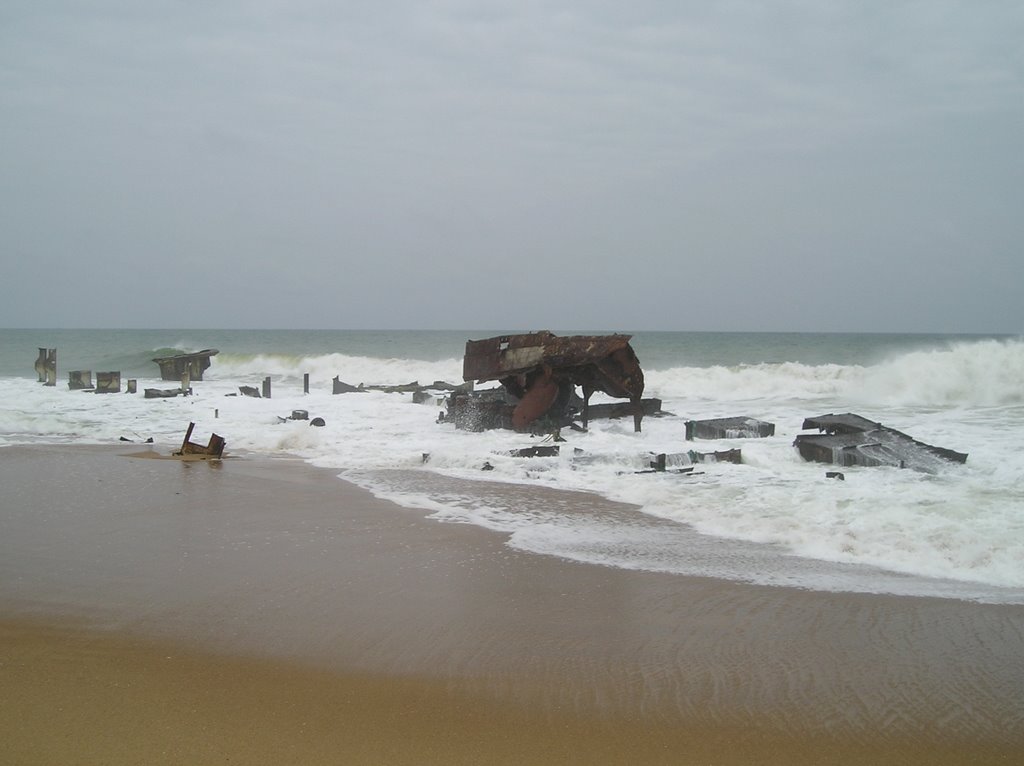
There wasn't much left of the ship. I think they said it had just ran aground in 1998, and the villagers thought the ship, with its load of furniture and goods, was a gift from the gods. They cleaned it out pretty quickly. But the hull and parts which were left there have really altered the beach and the sands of the whole peninsula as the tides were changed to go around the wreck. Now there has been a lot more sand deposited there and the village is much further from the water than it was before. I thought it was interesting how in just 7-8 years there could be such a big change in the whole land area of the peninsula.

Here's a picture of Brent giving some "dash" to the women in the village for allowing us to walk through their land and take their picture. Then, several of the villagers came down to the creek to help us push off.
It was quite amazing to have a real African jungle adventure!
Subscribe to:
Posts (Atom)