Thursday, August 31, 2006

The 17th good thing about Lagos: Fun escapes to the beach

Well, I've been back in Houston for a week and a half now and Brent's already back in Lagos busy with meetings. The week he was here was very busy with the company-required physicals and relocation meetings and screening sessions along with visiting kids and granddaughter up in Austin and looking at townhouses -- it was a whirl. And now that he's gone, life has settled back into a routine here that almost makes my time in Nigeria seem like a dream. It's such a different world from Houston that it seems kind of strange that it's all happening on the same planet. We still haven't decided if we're going to speed up and move fast, or take our time to make sure the project is not going to stall or fall apart and wait to sell the house next spring. There's a lot to do around here to get the house ready to sell -- it makes me tired just thinking about it. But I'll keep plugging away at it.
I never gave a report on our last fun Saturday in Lagos. The ConocoPhillips managing director and his family had just returned from summer vacation in the States on Friday and they were very kind to invite us to go with them to the company beach hut for an outing on Saturday. They said they try to make a point to take visitors there to show them that there is a place to go to escape the filth and crowds of Lagos and get a little bit of escape. We really enjoyed getting to know them and had a great day. It certainly is the way to have an outing at the beach -- there's guys around to load the gear in the car and then to take it from the car to the boat and to have the boat ready and drive you there and then tote it from the dock to the beach hut and to watch over the kids while they play and swim while you relax and play bocce and they cook your dinner and clean up and load the stuff back in the boat when you're ready to leave, and clean up the boat when you return, etc. It's a much more relaxing outing than it would be here in the States. (Not to mention that the guys are toting an AK-47 so you can relax and forget that there may be dangers around you.) You can see the beach hut is really very nice. And the Atlantic Ocean beach was beautiful!
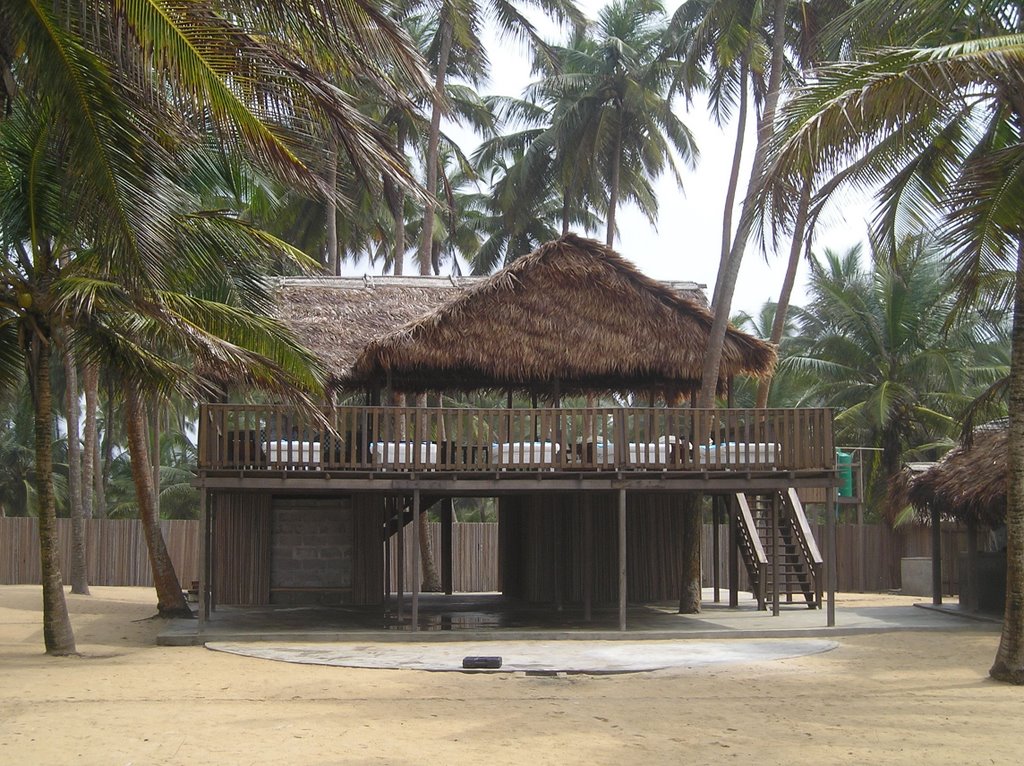


To get there, it's about a 45 minute speedboat ride up the "creek" from Lagos -- it's really quite a wide river which, thankfully, is upstream from the filth of the city. You see views like the pictures below with people doing business and fishing on the river and ferrying across.


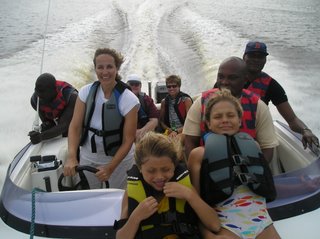
The boat dock was on the creek, and we walked across the sandy peninsula (maybe 200 yards) to the beach house, which faces the Atlantic beach. There's coconut palms and one of the guards shimmied up one to cut us down a fresh coconut. Todd and the girls went waterskiing, but I chose not to on this trip, as it was kind of overcast and actually chilly. Wading was as wet as I got. We had a fun expedition to a shipwreck site, which I'll put in another post. All in all, it was a great day. They let me drive the boat on the trip back and I was proclaiming "I AM DRIVING A BOAT IN AFRICA!" It's really amazing the turns that life takes that I never would have dreamed I would experience!
Thursday, August 24, 2006

The 16th good thing about Lagos: The opportunity to leave the US and return and realize how good and easy life is here.

Well, after a 26 1/2 hour door to door journey, we arrived back in Houston right on schedule Monday afternoon (well, actually the flight was 5 minutes late -- but I think that's quite amazing after such a journey). Things went smoothly on all fronts. We had a limo waiting at Heathrow (paid for with our ticket price) to bring us to Gatwick for the flight to Houston, so that was very convenient and easy. We did avert a near disaster in Gatwick: After checking in our luggage, the agent handed me our passports and boarding passes and Brent and I followed the guys who were toting our luggage over to the security screening area. We had to fight our way through long lines of people waiting to go through the security checkpoint. After leaving our luggage in the proper place, we were looking for the end of the security line and I realized I only had one passport with our boarding passes -- Brent's was missing. I immediately went back to the gate agent and asked her if she had forgotten to give me one of the passports, and she assured me that she had given them both to me. My heart rate jumped about 20 points. She asked if we had maybe put one away and we did look -- but I knew that I had kept the travel documents in my hand. She made an announcement about a lost passport over the intercom and we proceeded to retrace our steps. After only a couple of minutes, Brent was handed the passport by a security guy who had found it dropped on the ground. I suppose it had slipped out while I was fighting my way through the crowds. Next time I will keep an even tighter death grip on my travel documents. That could have been a real disaster. The agent said that even though she had just seen the passport, there was no way in the present security climate that they would have allowed anyone to travel without a passport. Brent probably won't trust me to hold his passport again! After a pat-down at the initial security check point then, at the gate, they had another check where they were going through hand luggage and doing another passenger search. When Brent and I got to the head of the line, the security guy just passed Brent on through without a search at all. I hadn't seen him let anyone else pass by without a search! I don't know about that -- I think the one thing in common with all the airline terrorists so far has been that they are all male! I think I would be inclined to give a pass to the innocent looking female passenger. But, alas, I had to go through the screening and they confiscated my contraband British airlines business travel kit that we had received on our previous flight that I had thoughtlessly stuck in my carry-on bag, even though it contained dangerous tiny tubes of toothpaste and lip gloss (gels are forbidden), and small bottles of mouthwash and lotion. Of course, the kit was still sewn shut and each bottle or tube within was tamper-resistent sealed. But, it is possible that a crafty terrorist while in the airport between flights could have taken each bottle and replaced, for instance, the mouthwash, with a dangerous explosive substance and then replaced the tamper resistant seal and then sewn shut the travel case so it had appeared to be unopened. You never know... But I quickly assured the security screener that I wasn't too attached to the items and she was welcome to them. I think she was extra thorough with the pat-down after that, as I was a proven offender.

Anyway, we were very relieved when arriving home and finding all was well. I only had time for a quick shower before going to a Symphony chorus rehearsal -- so it was right back into activity. But the biggest first impression of being home is one of comfort and ease. The ability to brush one's teeth without using bottled water. To go to the grocery store and have such a plentiful and relatively inexpensive bounty of items to choose from. To make a salad or eat some fruit without soaking the produce in bleach for 20 minutes. To get in the car and drive where I want when I want without real security worries (well -- at times having a driver would be a real plus in Houston traffic!) and to have traffic laws that you generally expect will be followed. To be able to walk around my neighborhood freely on streets that are not lined with trash and beggars and people who have set up their home underneath a cloth held up with sticks because there is no other place for them to live. The poorest people here have it so much better than so many millions of Nigerians because here there is the opportunity to find assistance should someone pursue it and here there are possibilities that the poorest Nigerians can't even imagine. There are some really great things about life in the USA.

We had some fun experiences in our final days in Lagos that I haven't written up yet -- so there's still some "good things in Lagos" yet to be recorded. Stay tuned!

Saturday, August 19, 2006

The 15th good thing about Lagos: Stewards and Stewardesses

Until I got here, I knew of the word "stewardess" as an outdated term for a flight attendant. In Lagos, that is the term for your female househelp.

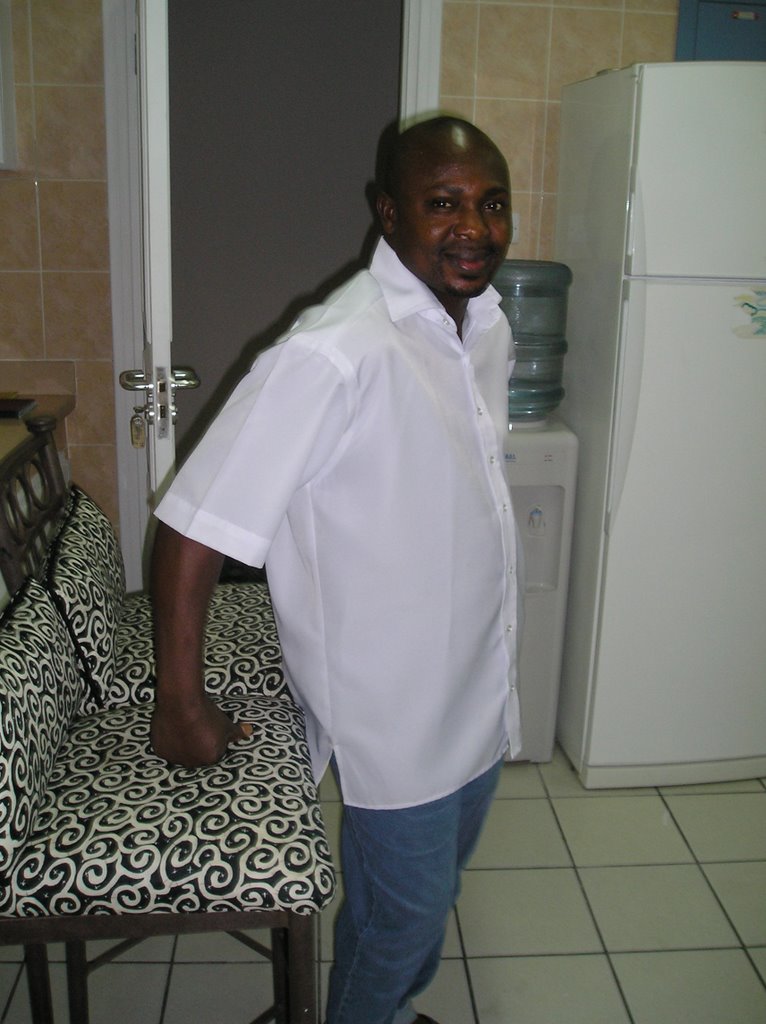
Below is a photo of Angela, a stewardess. I only got to know her for a few days before we left. She was in training to relieve the regular steward of our flat: Andy. Andy spent several days teaching her the ropes. Andy's not wearing his usual neat apron here because he's just about to leave on his month-long vacation. Angela is now ready to take over. Andy does some laundry, but we're careful about what we allow him to wash, as we've been warned he has ruined some clothes. He does dishes, cleans everything and is a meticulous ironer. He's also very pleasant to be around -- he's happy all the time and sings as he works. I've also noticed that Angela also hums as she cleans. Andy takes care of two flats because often there aren't many, or even any, people in them, as they are flats the company keeps for temporary people. While we're living here, the company pays for our househelp. They are contracted and paid by them, so that's a great perk to offset the difficulties of living in a 3rd world country. When we were over at friends for dinner, their steward, who is also a great cook, fixed a fabulous dinner. He's from the Republic of Benin where he learned to cook French, and he's great with presentation and loves cooking a beautiful meal. He even set the table with a fancy folded napkin at each setting. And then he cleaned up while we visited after dinner. I could get used to having a steward or a stewardess around the house!

Friday, August 18, 2006

The 14th good thing about Lagos: Everyone speaks English (sort of)

We've had foreign assignments before -- we lived in Norway and in Dubai. Both places had populations with a high percentage of people that spoke English. While in Norway I studied Norwegian and, because German was my language of study in college and Norwegian is a very similar language, I was able to confuse the two very easily and speak a strange kind of English/German/Norwegian dialect of my very own. And I studied Arabic while we were in Dubai, but there was no expectation that we would actually learn to SPEAK it, at least anything beyond greetings and such. It was mostly a cultural class. Anyway, most the people you really needed to communicate with when shopping or eating out spoke Urdu or some other Near Eastern language. But even though the "natives" in these places were able to speak English, darn it all, they preferred their native language and conversed easier in it so it was often difficult to have good discussions about differences in our respective cultures. Our language differences were often a barrier. Here, thankfully, that barrier doesn't really exist. Though Nigerians do have different native dialects, at least here in Lagos, they are all very comfortable speaking in English and that's the language that most of them communicate with each other. In the car last week with a security man and the driver, I asked them about their languages and they said they came from different parts of the country and their first languages were different, so they spoke to each other in English -- and that's what most of the Nigerians do. Dairu listed off several of the common tribal languages and said also many people speak "pidgin English." I asked him if I would understand someone speaking pidgin, and he said I might catch a word here and there, but I probably wouldn't understand much of it. Actually, after being here almost 2 weeks, today was the first time I heard Nigerians speaking to each other in something other than English. I was taking a tour of the Ikoyi golf club to see if we might want to join it when we come for good(the company pays for our membership in one club of our choice because of the limited social activities available in the community), the guy showing me around spoke to one of the workers in another tongue and I asked him what language he was speaking and he said it was Yoruba. My guess is that Yoruba is the most common native language in this part of the country. But English is used for all signs and business and general communication because this country was colonized by the British. Although it is often difficult to understand the English of some Nigerians and at times I have to ask them to repeat what they said -- it is still lots easier to have the expectation of conversing and understanding each other. I'm learning a lot more about these people and their lives because I'm able to ask them about themselves and, usually, I'm able to understand what they tell me.

Thursday, August 17, 2006

The 13th good thing about Lagos: You can get some help and make a boy's day for only 100 naira (about 70 cents).

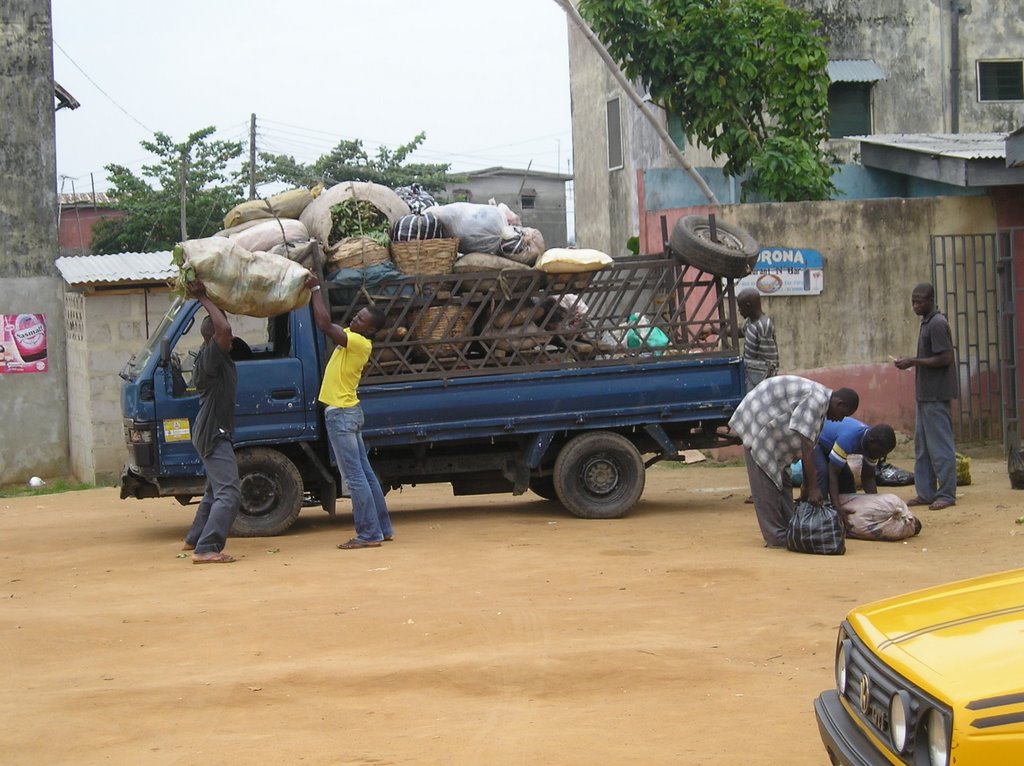
I've gone to the Lekki market twice now -- it's a good place to buy African handicrafts, though you can find just about anything there -- I saw a Mary Kay cosmetics sign this last visit. The instant you drive into the parking area there, your car is surrounded by young boys who want to be your helper for your visit. We were advised to choose one -- and insist on only one -- and get his name. He is the one that will follow you around to the stalls and carry your purchases. There will be others that also follow you for a while, with the hope that you may need more help, so you must continue to insist that you only need one boy to help you (even if you really don't need anyone to help you, I was told it's easier to choose one, or else you will continue to be harassed throughout your shopping trip). When I went yesterday with my new friends and advisors, Angela asked for John, who is her regular helper. Here's a photo of John and his friend. Also below is another picture of other workers at the market -- people unloading goods from a truck.


I wish I had gotten a photo of Philip, who was our helper on my first visit to the market with Brent. We decided we would choose the smallest boy and we got Philip, who seemed to be a very smart kid. He brought us to some stalls where I could get a delicious pineapple and some vegetables and he advised me about prices. He led us through the maze of shops and showed us where to look for different items. He asked us to request him next time we came -- he said if we didn't see him to tell the boys we want Philip and they will find him. But he warned us that he is only at the market on weekends. He proudly said that he went to school during the week. Brent said "that's a very good place to be -- you need to stay in school." Brent asked Philip what he wanted to be when he grew up, and Philip said he wanted to be an accountant. Brent assured him that being an accountant is a good job to have and he should stay in school so he could do that. At the end of a visit to Lekki market, when all your purchases are in your car, you give your boy-helper 100 naira, and they walk away, pleased to have been the one chosen to help you.

The 12th good thing about Lagos: Varied shopping available from your car window on the Falomo bridge

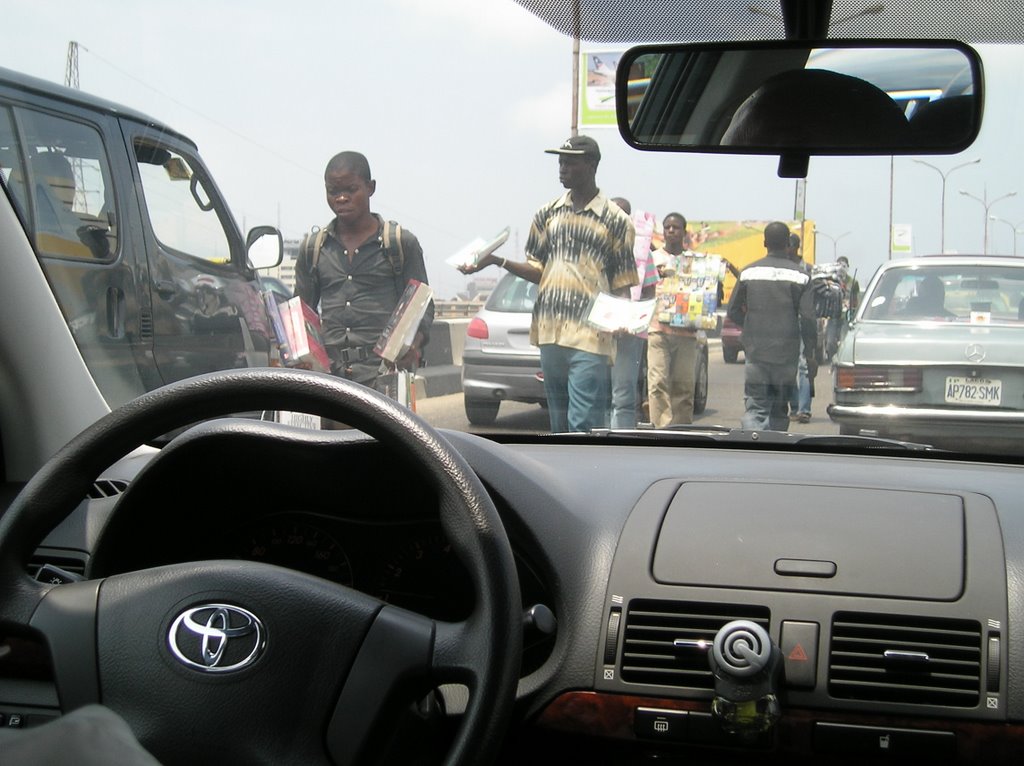
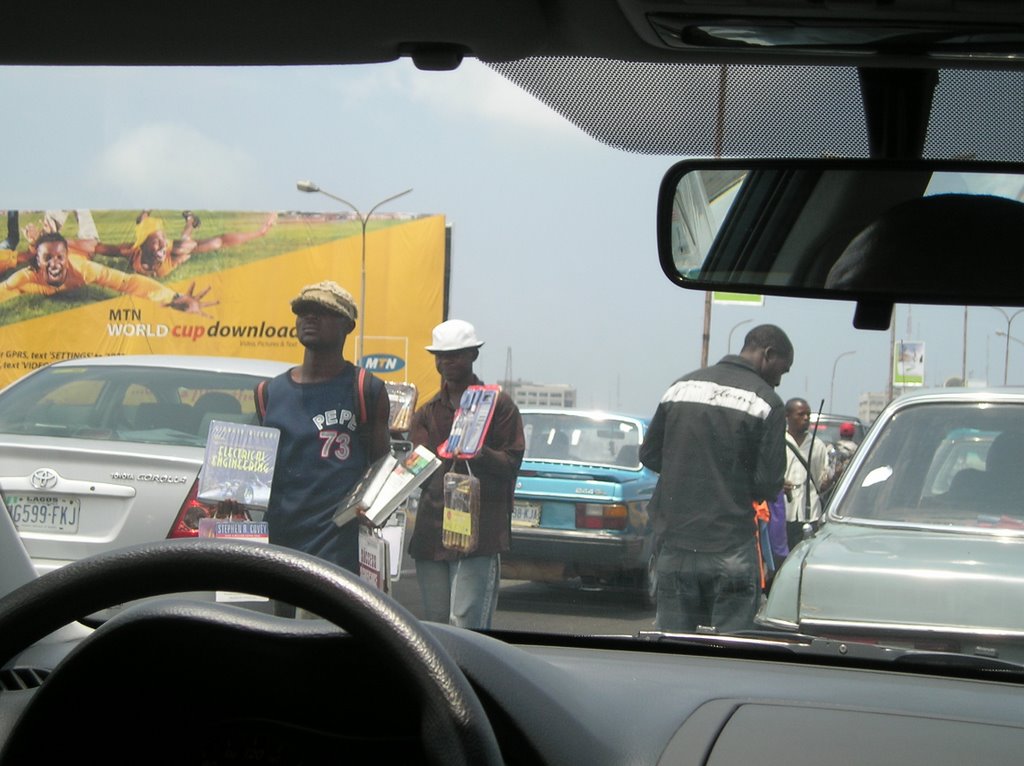
Brent and I went out this morning with some company people to look at a residential building on the neighboring island of Ikoyi. There are a couple of bridges connecting Ikoyi and Victoria Island (VI), where the office and our current apartment building is. Ikoyi is a little less busy than VI and has some trees, which, for some people, makes it a more pleasant place to live. The biggest downside of living there would be the commute across the Falomo bridge. We were coming back across the bridge around noon, which is a very busy time to be on this road. Because there's such a bottleneck of traffic, the place teems with foot vendors which, naturally, compound the traffic tie-ups. These very brave and enterprising (and probably desperate) sellers weave between the cars and look to you inside your car, pleading with you to buy their wares. With some of them, a shake of the head is enough to make them move on. With others, they seem to be certain that if you are given the opportunity to look at their wares long enough, you will certainly see the value of buying from them. Here's a list of some of the items I could have purchased today crossing the bridge, though we had been on the bridge for about 10 minutes before I decided that I had to make a list and pulled out my paper and pen.

Things for sale today on the Falomo bridge:

1. car mats
2. knives
3. cellular phone cards to recharge your phone account -- these are for sale on every street in the city
4. books --one textbook on electrical engineering I've seen several times, also Covey's "Seven Habits of Highly Effective People" and "Who Moved My Cheese" -- many religious books like illustrated Bibles as well as children's books
5. pants
6. some interesting fake-bronze (maybe plastic?) sculptures -- the ones I looked at were of a golfer and a tennis player
7. sets of kitchen tools
8. individually wrapped cakes that look like Twinkies
9. bottles of soda and water
10. pens
11. CD rack
12. CDs and DVDs
13. bananas
14. picture frames
15. candy and gum
16. Wahl hair clipper sets
17. cleaning brushes of many varieties
18. a cutlery set with wicker holder
19. peanuts
20. Nigerian mens clothing
21. bags of potatoes
22. drink boxes
23. watches
24. suitcases
25. paintings -- on canvas and "special" ones on velvet
26. lighters
27. magazines -- including Vogue and Reader's Digest
28. tape measures
29. a hand riveter
30. wallets
31. cell phones
32. light bulbs
33. plantain chips
34. hats
35. toys
36. newspapers
37. rugby shirts
38. sunglasses
39. eye glasses
40. belts
41. clocks
42. tomatoes
43. potato chips

And in addition to the vendors, we have the beggars come to our windows with pleading eyes -- mothers carrying two small babies, one in front and one in back. Little children leading their blind fathers, people with missing limbs, today a little girl who walked along with us repeating "Master, please help me, master." We are advised to not give to the street beggars -- some of them are scam artists, borrowing children or the handicapped to prey on the sympathies of the public, and many of them are actually placed there by pimps who get most of their profits. But it is very difficult to turn my head and turn off my sympathies. I hope that while I'm here I won't lose my feelings of compassion -- I just know I'll have to find other ways to give.

As for the shopping, our driver says that for security reasons, as well as other reasons, we really can't buy anything from the vendors along the street. What lost opportunities! I'm still mulling over the value of that toilet seat I could have bought from the car last week -- you don't see those for sale every day!

Wednesday, August 16, 2006

The 11th good thing about Lagos: Generators

Probably an average of about 6 times a day everything electrical will suddenly go off and there will be a lag of around 5-10 seconds before the generator kicks in and power is restored. Many people who have been here for a while don’t even notice it at all. But, to me, it’s still a little a bit of a surprise. It’s been a big surprise several times when I’ve been jogging at a pretty good clip on the treadmill and it has come to a dead stop. After the first time, when I almost fell flat on my face, I’ve learned to be prepared to suddenly grab the handrails to support me at the first sign of a drop in power. There’s never any visible signal of when the power actually comes back on and the generator stops doing its work. Most apartment buildings with expatriates (us needy ones) have 2 generators so there is a backup if the first one goes out. Also, many expatriates have a UPS or two – a universal power supply, so when the sudden drop of power comes, it doesn’t stop your computer or TV or whatever else you want to plug into it to avoid the short interruption of power. Today I was doing some exploring and shopping with my new women friends here and we stopped at their building to drop off some perishables and we were heading out again when their gate guard stopped us and said that they were about to do some work on their generators and their power would be off for an hour and they should unplug their computers and any other things electrical so nothing would be damaged if there was a power surge when they got things going again. They were grateful for the notice and we went back up to their apartments and scurried around turning things off. We were laughing at ourselves later about how we were all kind of running around in a panic to protect those things which, naturally, they didn’t want damaged. I was reminded of something the Nigerian security man said the other day when I went with some company people checking out possible buildings for them to acquire for expatriate housing. He said “the most fearful person is a rich man -- the poor have no reason to fear.” There’s some truth in that.